


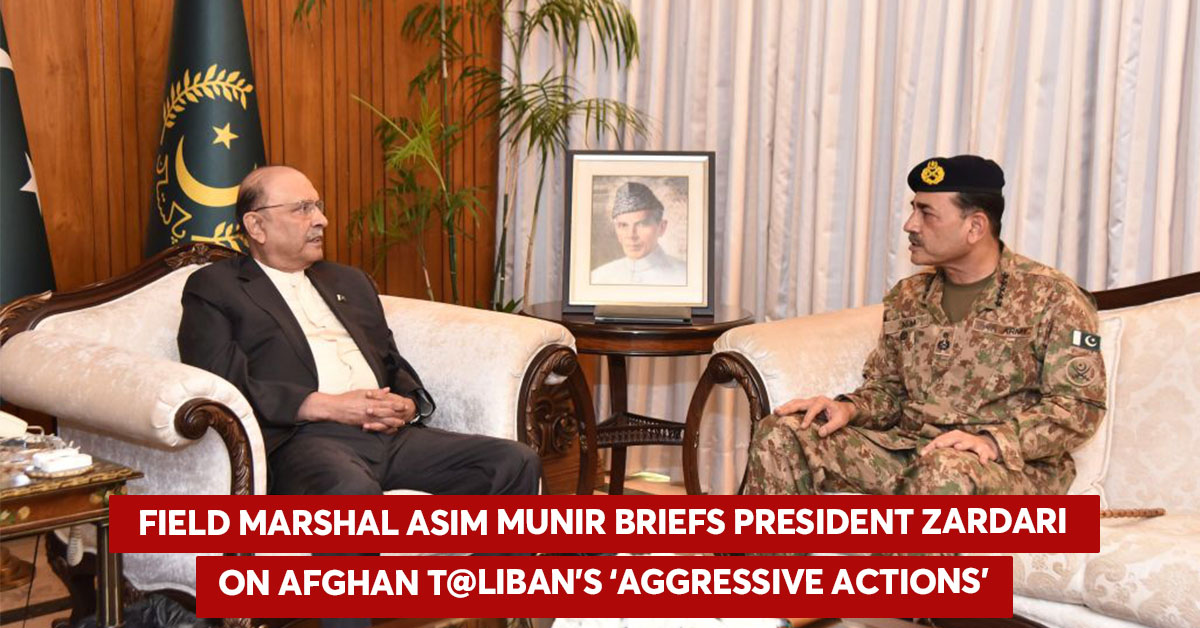
Field Marshal Asim Munir Briefs President Zardari on Afghan Taliban’s ‘Aggressive Actions’
Pakistan’s Leadership Discusses Escalating Border Situation
Field Marshal Syed Asim Munir, Chief of Army Staff, briefed President Asif Ali Zardari on Wednesday about the recent “aggressive and provocative actions” of the Afghan Taliban regime. The meeting took place at Aiwan-e-Sadr in Islamabad, amid growing tension along the Pakistan-Afghanistan border.
During the briefing, the COAS outlined the internal and external secu-rity environment and described the military’s “measured and befitting response” to repeated border att@cks. Afghan forces, supported by affiliated militant groups, have been targeting Pakistani border areas since last week, triggering intense clashes.
According to military officials, Pakistani forces eliminated more than 200 Afghan and foreign militants in retaliatory strikes while 23 soldiers embraced martyrdom. The operations targeted Taliban posts, militant training centers, and cross-border hideouts used for launching att@cks on Pakistani positions.
President Zardari Reaffirms Confidence in Armed Forces
President Asif Ali Zardari expressed complete confidence in the strength, valor, and preparedness of Pakistan’s Armed Forces. He commended their vigilance and swift response in defending the nation’s borders.
“The people of Pakistan stand behind their armed forces,” the president said, adding that Pakistan will defend its sovereignty and territorial integrity under all circumstances. Zardari praised the troops for displaying professionalism while ensuring that the response remained “effective yet proportionate.”
Meanwhile, the military confirmed that Afghan Taliban units had relied on elements of Fitna al-Khawarij to strike border regions such as Angoor Adda, Bajaur, and Kurram. Pakistani forces struck back with precision fires and raids, neutralizing several Taliban assets.
New Clashes and Regional Reactions
The situation remained tense as fresh skirmishes erupted early Wednesday. Afghan Taliban fighters launched another wave of att@cks in Spin Boldak, Balochistan. Pakistan’s forces quickly repelled the assault, killing up to 20 militants and destroying eight Afghan posts, including tanks and vehicles.
These developments have drawn concern across the region. Countries such as Saudi Arabia, Qatar, Iran, and Russia have urged both sides to de-escalate and engage in dialogue. Analysts warn that continued confrontation could destabilize border communities and affect regional trade routes.
The renewed hostilities coincided with an official visit by a Taliban diplomat to India, during which he made critical remarks about Pakistan. Observers view the timing as significant, suggesting growing geopolitical friction in South Asia.
Outlook: Strength, Restraint, and Diplomacy
Pakistan’s leadership continues to emphasize measured responses and strategic restraint while safeguarding national sovereignty. Field Marshal Munir’s briefing reflects a broader shift toward proactive defense and regional engagement.
Officials say that Islamabad remains open to dialogue but will respond firmly to any violation of its territory. For now, Pakistan’s Armed Forces remain on high alert as diplomatic efforts intensify behind the scenes.
