


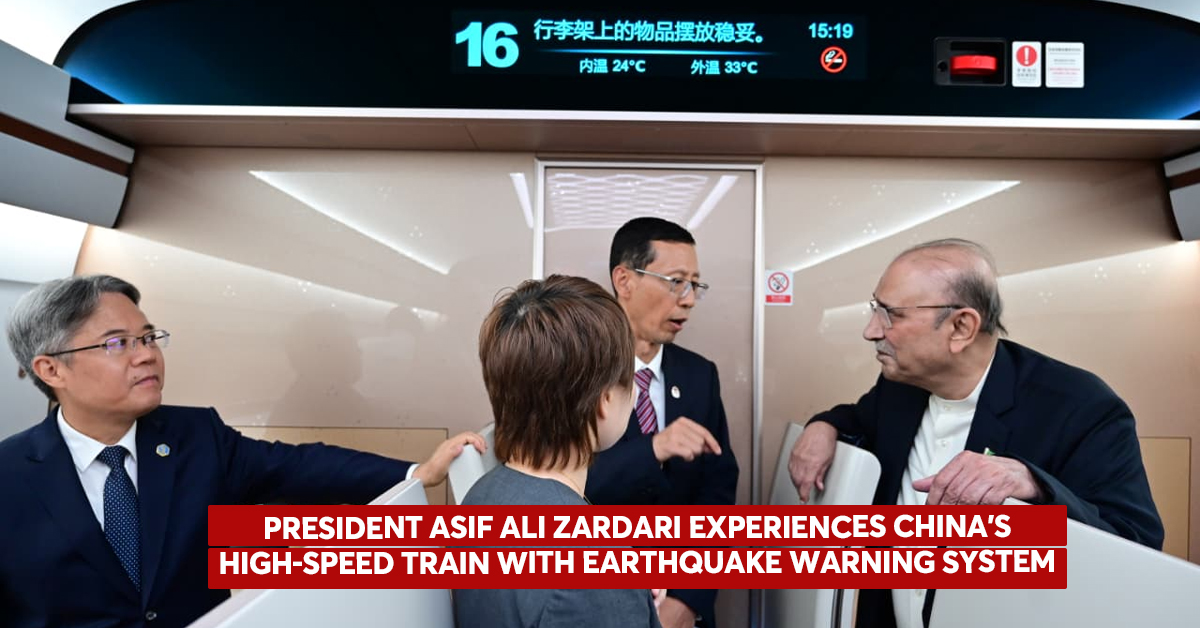
President Asif Ali Zardari Experiences China’s High-Speed Train, Calls it a Model for Sustainable Transport
Mianyang, September 14, 2025 — President of Pakistan Asif Ali Zardari on Sunday undertook a landmark journey on one of China’s high-speed trains, traveling from Chengdu to Mianyang in just half an hour. The visit offered the president firsthand exposure to the world’s most extensive and technologically advanced high-speed rail network, which has become a global benchmark for connectivity, innovation, and sustainability.
The Journey: Chengdu to Mianyang in 30 Minutes
The president, accompanied by Pakistan’s Ambassador to China Khalil Hashmi, Chinese Ambassador to Pakistan Jiang Zaidong, and Senator Saleem Mandviwalla, boarded the train at Chengdu. The journey, which would normally take several hours by conventional rail, was completed in only 30 minutes — highlighting the efficiency of China’s high-speed rail system.
During the trip, officials briefed the president on the operational aspects of the trains, including safety measures, service delivery, and environmental benefits. With trains capable of reaching speeds of 350 km/h, China’s rail system represents a paradigm shift in modern connectivity.
Praise for Sustainable Innovation
President Zardari expressed admiration for China’s commitment to green technology, particularly the use of pollution-free electric propulsion and earthquake early warning systems integrated into the network. He described these advancements as a “marvel of railway engineering” and emphasized that such systems provide valuable lessons for Pakistan as it looks to modernize its own transport infrastructure.
“China’s achievements in building a resilient and eco-friendly rail network are a model for countries like Pakistan,” the president remarked, noting that investments in sustainable infrastructure could strengthen connectivity, reduce environmental footprints, and ensure safety in seismic-prone regions.
China’s Expansive High-Speed Rail Network
Officials highlighted the sheer scale of China’s achievement: a 45,000 km-long dedicated high-speed track system, the largest in the world, serving over 2 billion passengers annually. This vast network links nearly all major Chinese cities, reducing travel times dramatically and making rail travel the preferred choice for millions.
The standardization of trains and the establishment of a dedicated passenger system have made China a global leader in transport innovation. From engineering resilience to environmental consciousness, the system reflects decades of strategic planning and investment.
Lessons for Pakistan
President Zardari’s ride carries significant implications for Pakistan’s future transport strategy. Pakistan has long struggled with outdated rail infrastructure, slow connectivity, and limited investment in sustainable transit. As the country seeks to modernize under initiatives like the China-Pakistan Economic Corridor (CPEC), China’s rail experience serves as a valuable guide.
Potential lessons include:
-
Green Propulsion: Adoption of electric systems to reduce reliance on fossil fuels.
-
Safety First: Earthquake and disaster early warning integration for a seismically active region.
-
Connectivity: Linking major Pakistani cities with high-speed passenger routes to boost trade, tourism, and employment.
-
Sustainability: Building eco-friendly networks that balance growth with environmental protection.
A Symbol of Pak-China Cooperation
The president’s journey also underscored the depth of Pakistan-China relations, often described as “higher than the Himalayas and deeper than the ocean.” By personally experiencing one of China’s most prized technological achievements, President Zardari reaffirmed Pakistan’s interest in learning from China’s expertise and potentially replicating elements of its high-speed rail system under CPEC.
The Broader Visit
Alongside the president’s journey, it was also noted that PPP Chairman Bilawal Bhutto Zardari and First Lady Asifa Bhutto Zardari arrived in Shanghai as part of the extended visit. Their presence highlights the political and symbolic importance of the trip, emphasizing continuity of ties between Pakistan’s leadership and Beijing.
A Vision for the Future
As Pakistan contemplates its development trajectory, sustainable transport remains a pressing issue. With urban populations expanding and demand for mobility rising, the need for fast, safe, and green transit systems is more critical than ever. President Zardari’s remarks suggest that Pakistan may consider incorporating high-speed rail technology and environmental safeguards into its future infrastructure plans.
For now, the Chengdu-to-Mianyang trip stands as more than just a train ride — it symbolizes the aspirations of a nation eager to learn from its ally and chart a path toward modernization.
