


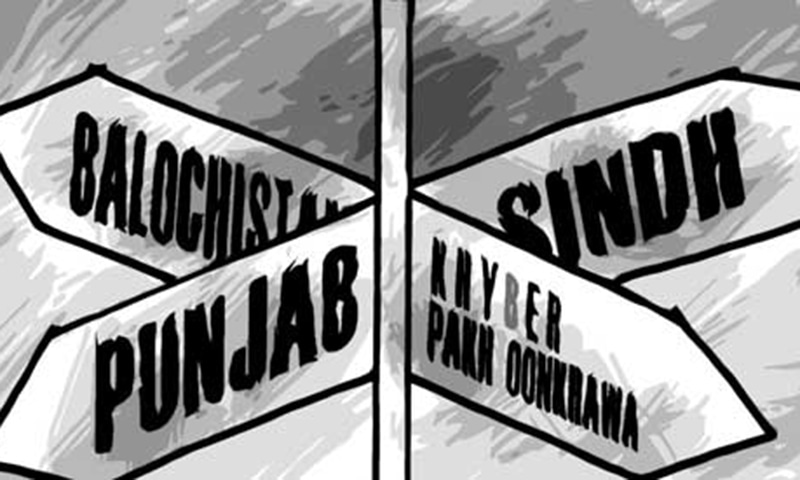
Pakistan has long been plagued by demands for new provinces, with proponents arguing that carving up the country further would resolve administrative inefficiencies and improve governance. However, this perspective ignores the real issue: the failure of local government and systemic corruption at the grassroots level.
The notion that people’s problems stem from a shortage of officials rather than the incompetence and corruption of existing ones is misleading. The real question is not about increasing administrative units but about fixing the deeply entrenched governance issues within the current system.
A common misconception driving the push for more provinces is that districts suffer due to a lack of administrators. In reality, the issues faced by the common citizen whether in obtaining land records, accessing justice, or securing basic services stem from widespread corruption among officials already present.
The Patwari (land record officer) manipulates land data for personal gain, the Thanidar (police station chief) prioritizes bribes over justice, and district officials remain more invested in personal enrichment than public service. Increasing the number of provinces will not miraculously change the character of these officials; rather, it will multiply the administrative chaos and corruption, making governance even more cumbersome.
Take, for example, the case of Punjab. Despite being Pakistan’s largest province, it is not a lack of officials that hinders progress; it is the unchecked corruption and inefficiency at the local level. The bureaucracy remains unaccountable, while powerful feudal lords and political elites continue to exploit the system. Creating another province will not resolve this it will only distribute the same corrupt governance model into smaller units.
The demand for new provinces in Pakistan is often not rooted in administrative necessity but in ethnic and linguistic divisions. Calls for a Seraiki province in Punjab or a Hazara province in Khyber Pakhtunkhwa are less about efficiency and more about identity politics.
This exacerbates existing divisions rather than fostering national unity. Instead of further dividing the country along linguistic lines, Pakistan should focus on creating inclusive provincial identities that represent all ethnicities residing in them.
One effective way to counter these divisions is by changing the names of provinces to reflect a neutral identity. For instance, renaming Punjab to a more inclusive term that does not exclusively signify Punjabi ethnicity could help in diluting linguistic biases.
Similarly, instead of a linguistic name like Sindh, a neutral name that reflects historical or geographical significance rather than ethnic identity could foster greater unity. By doing so, the argument for new provinces based on linguistic exclusivity loses its ground.
International examples also prove that governance, not provincial fragmentation, determines progress. India, despite having multiple states, still struggles with governance issues at the local level. Conversely, China, with fewer administrative divisions, manages a much larger population efficiently through strong governance mechanisms. The focus should be on improving the system rather than redrawing administrative boundaries.
Pakistan does not need more provinces it needs competent local governance. Decentralization should be done at the municipal level, ensuring that local representatives are held accountable for service delivery. Instead of increasing the number of chief ministers and governors, empowering district administrations and ensuring transparency at the grassroots level should be the priority.
Moreover, digitization of land records, police reforms, and independent accountability mechanisms can address many of the issues citizens face. The focus should be on governance, transparency, and the rule of law—not on redrawing maps to appease ethnic groups.
The argument for creating more provinces in Pakistan is a distraction from the real problem: governance failure. Rather than multiplying administrative units, Pakistan must fix its existing structures. The calls for new provinces are often politically motivated and do not address the root causes of people’s suffering.
Instead of dividing Pakistan further along linguistic lines, the focus should be on good governance, accountability, and inclusive provincial identities. Only then can Pakistan move toward real progress.
