


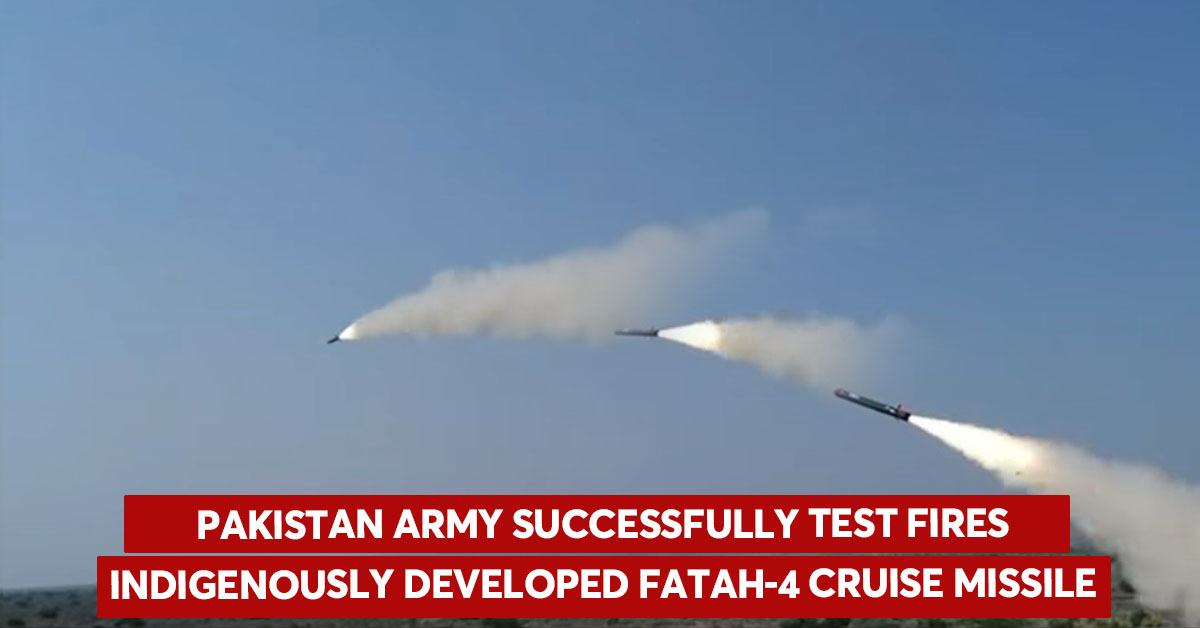
Pakistan Army successfully test fires indigenously developed Fatah-4 cruise missile
The Pakistan Army carried out a successful training launch of the newly inducted, indigenously developed Fatah-4 cruise missile. The weapon system, capable of striking targets with high precision at a range of 750 kilometers, marks a significant step in strengthening the country’s conventional deterrence capabilities.
Advanced Capabilities of Fatah-4
According to the Inter-Services Public Relations (ISPR), the Fatah-4 is equipped with advanced avionics and state-of-the-art navigational systems. Its terrain-hugging flight profile enables it to evade enemy missile defense systems, while maintaining the ability to strike designated targets with accuracy.
The cruise missile forms part of the Army Rocket Force Command, which plays a central role in enhancing the reach, lethality, and survivability of Pakistan’s conventional arsenal.
Successful Training Launch
The training fire was conducted to validate operational readiness and system performance. Senior officers from Pakistan’s armed forces, including the Chief of General Staff, as well as teams of scientists and engineers, witnessed the launch.
ISPR emphasized that the successful demonstration reflects both the technological advancements achieved by Pakistan’s defense industry and the professional competence of the armed forces.
National Leadership Congratulates Troops
Following the test, the President of Pakistan, Prime Minister, Chairman Joint Chiefs of Staff Committee (CJCSC), and services chiefs extended their congratulations to the troops, scientists, and engineers involved in the project. The leadership highlighted the launch as a milestone for Pakistan’s indigenous defense development and operational preparedness.
Previous Fatah-Series Launches
The Fatah-4 test comes months after the Pakistan Army successfully carried out a training launch of another Fatah-series surface-to-surface missile with a range of 120 kilometers during the “Exercise Indus” in May. The continued induction and testing of these systems reflect Pakistan’s efforts to modernize its conventional missile capabilities.
Strategic Importance
Defense experts note that the Fatah-4’s combination of long-range capability, terrain-hugging features, and advanced guidance systems will enhance Pakistan’s ability to safeguard its national security interests. The missile is seen as a significant addition to the country’s strategic toolkit, ensuring deterrence and balance in the region.
Conclusion
The successful training launch of the Fatah-4 cruise missile demonstrates Pakistan’s commitment to advancing its indigenous defense technology while ensuring operational readiness of its armed forces. With leaders praising the collaborative efforts of troops, scientists, and engineers, the test marks another milestone in the evolution of the nation’s missile program.
