

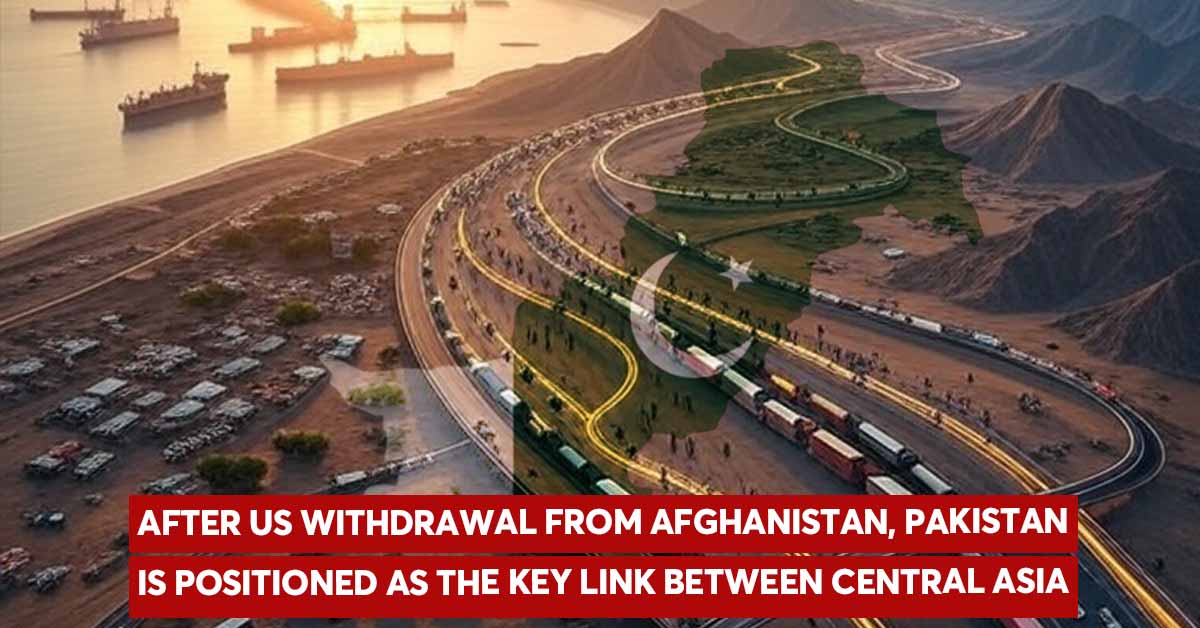
After the US withdrawal from Afghanistan, Pakistan is positioned as the key link between Central Asia and global markets.
The US withdrawal from Afghanistan in 2021 reshaped the Eurasian power map. Without a direct presence, Washington now seeks new ways to protect its strategic and economic interests. Pakistan, with its geographic position, emerges as the natural land bridge connecting the resource-rich Central Asian Republics to global markets.
This is not a new role. For centuries, trade routes like the Khyber Pass linked East and West. Today, the $482 million Khyber Pass Economic Corridor, part of the wider CAREC network, is reviving these historic arteries. Once completed, it will connect Uzbekistan and Tajikistan to Pakistan’s ports at Gwadar and Port Qasim, offering secure and cost-effective access to global trade.
For the US, the corridor is about more than commerce. It provides strategic leverage, offers stable alternatives to northern transport routes, facilitates humanitarian aid to Afghanistan, and supports regional energy projects such as CASA-1000 and the TAPI pipeline.
Challenges remain, including threats from the TTP, BLA, and Afghan instability. Yet, with targeted US investment in infrastructure, logistics, and technology — alongside Pakistan’s commitment to border se-cu-rity — the partnership could transform the region, positioning Pakistan as the pivotal gateway for Eurasia’s stability and prosperity.
