

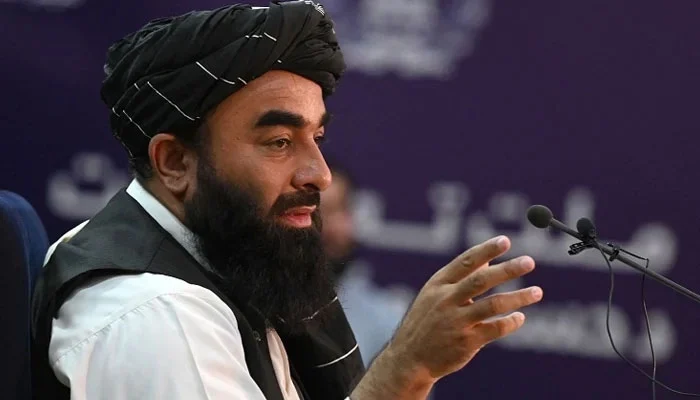
Taliban criticize UN report ahead of Doha meeting, labeling it an attempt to tarnish perceptions before the international conference. Zabihullah Mujahid, the chief Taliban spokesman, stressed the need for constructive and positive engagement between their government and the international community.
His comments followed a report by Richard Bennett, the U.N. special rapporteur, who accused the Taliban of intensifying violations of women’s and girls’ rights. Bennett presented his report to the U.N. Human Rights Council in Geneva, demanding accountability for those responsible for human rights abuses in Afghanistan.
Mujahid stated, “Some members of the United Nations, particularly the report by Richard Bennett, are attempting to tarnish perceptions ahead of the upcoming Doha meeting.” He added that certain individuals within the UN are distorting Afghanistan’s image and overshadowing significant progress with limited issues.
U.N. Secretary-General Antonio Guterres has called a two-day conference of international envoys in Doha on June 30. The Taliban will attend for the first time, in what will be the third meeting hosted by Qatar since Guterres started the process over a year ago. The U.N.-led dialogue aims to establish a unified global approach to engaging with the Afghan government, which is not yet formally recognized by the world.
Bennett emphasized the importance of Afghan civil society, including women human rights defenders, participating in the Doha meeting. He insisted that women’s and girls’ rights be addressed both directly and in thematic discussions.
Mujahid responded, “It is hoped that reality will be understood, and a constructive stance will be adopted.”
Human rights groups have criticized the U.N. for inviting the Taliban to the Doha meeting instead of holding them accountable for crimes against Afghan women and girls. They are also concerned that Afghan civil society and human rights activists will be excluded from the upcoming session under Taliban pressure.
On Tuesday, Farhan Haq, the U.N. deputy spokesperson, defended the decision to invite the Taliban. He did not confirm whether Afghan civil society representatives would meet with the de facto government. “At this stage, the arrangements for the conference are still ongoing,” Haq said at a news conference in New York.
“This is a key concern, and we want to ensure the rightful role of women in society is respected in Afghanistan, as it needs to be everywhere in the world,” Haq added. He stressed that the U.N. treats the Taliban as the de facto authorities, not the recognized government of Afghanistan.
Guterres did not invite the Taliban to the first Doha meeting in May 2023, and the de facto rulers refused to join the second in February unless their delegates were accepted as the sole representatives of Afghanistan.
The Taliban’s foreign ministry announced on Sunday that they would send a delegation to the third Doha meeting after two months of discussions with the U.N. regarding the agenda and participation list. “If there are any changes to the agenda and participation, it would naturally affect our decision, which we will share with all sides at that time,” the ministry stated.
The Taliban returned to power in Kabul almost three years ago, imposing severe restrictions on Afghan women’s rights and freedom of movement according to their strict interpretation of Islam. Girls aged 12 and older are banned from attending secondary school, and women are prohibited from working in most sectors, including the U.N., except for healthcare and a few other areas. Women cannot travel long distances without a male relative and are banned from public places like parks, gyms, and bathhouses.
The Taliban dismiss international criticism of their governance and calls to reverse restrictions on women as interference in Afghanistan’s internal affairs.
