



Terrorism is gaining momentum in Pakistan again. The rise of suicide attacks in Pakistan is a sign that terrorists have roots in almost every nook and corner of the country, especially in KP. The suicide attack in the mosque of Peshawar on January 30th is clear proof that our security agencies are not completely successful in eradicating terrorism, but their eternal sacrifices cannot be denied.
On Tuesday, the aftermath continued as bodies were retrieved from the wreckage. The explosion occurred during Monday afternoon prayers and resulted in over 102 deaths and 150 injuries.
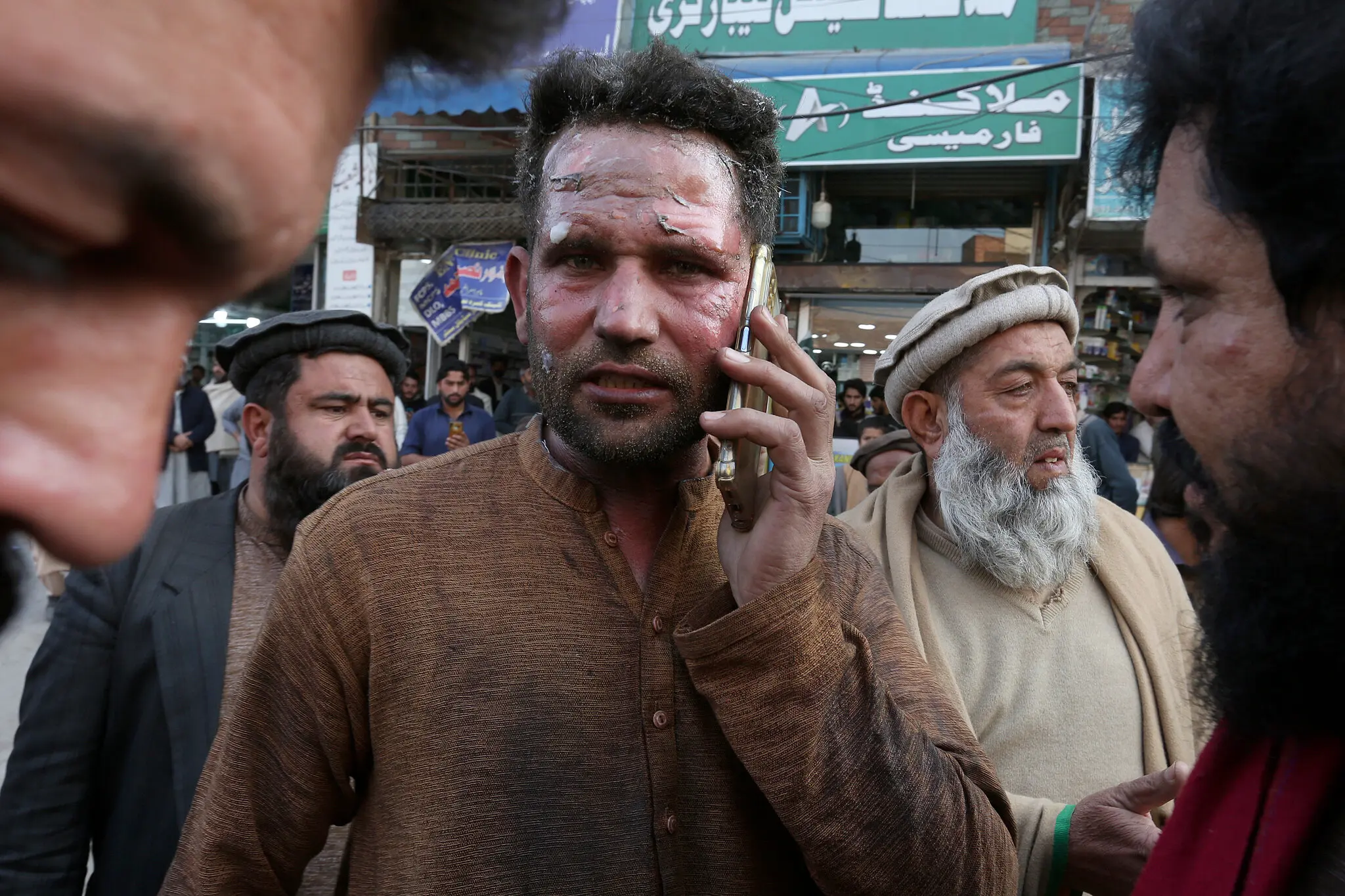
In a shocking attack, police officers who were worshipping in the mosque located in a secure compound in Police Lines Peshawar were targeted. Search and rescue teams are still in the process of clearing the rubble after the roof of the mosque collapsed.
“The sheer scale of the human tragedy is unimaginable. This is no less than an attack on Pakistan,” tweeted Pakistan’s prime minister Shahbaz Sharif, who visited the wounded in a Peshawar hospital and vowed “stern action” against those behind the bombing.
Stories have been circulating about who was behind one of the most tragic attacks on Pakistan’s security forces in recent years. Initially, Sarbakaf Mohmand of the Tehreek-e-Taliban (TTP) declared it was a “revenge” for the death of TTP militant Khalid Khorasani last year. However, TTP spokesperson Mohammad Khurasani later denied any involvement, asserting that it was not their policy to target mosques or religious sites.
In the 1980s, Peshawar became a major staging area for local and international fighters opposing the Soviet-backed Afghan government across the border. A large number of Afghan refugees also arrived in the city.
Terrorism has left a scar on the city over the last several decades, with a series of attacks on local government buildings and shopping areas. It was also the site of the country’s most shocking terror attack in December 2014, when Taliban militants attacked and killed 147 students and teachers at an army-run public school. That attack sent shockwaves throughout the country, turning many people against the militants.
History of Suicide Attacks
Suicide attacks have been carried out for centuries by a wide range of individuals, groups, and communities. Suicide attacks are carried out by a variety of religious traditions and secular groups, as well as state and non-state actors, as evidenced by historical examples ranging from the biblical Samson to the medieval Ismaili Shi’a Assassins, and from the anarchist Narodnaya Volya to the Japanese kamikaze, and from the Afghan Taliban to the Pakistani Taliban. The modern phenomenon of suicide “terrorism”—the deliberate use of this mode of operation—is generally dated to the early 1980s.
The Iranian Revolutionary Guard Corps successfully instilled the concept of martyrdom for the sake of God into the self-awareness of individuals who formed or joined Hizb Allah, an umbrella organization of Shi’a groups that became the first modern organization to employ this tactic systematically, in the aftermath of the Islamic Revolution. Hizb Allah’s successful use of the tactic was quickly imitated, first by other militant Lebanese groups, then by Sri Lanka’s Liberation Tigers of Tamil Eelam (LTTE), the Kurdistan Workers’ Party (PKK), and a number of Palestinian groups, including Hamas and Palestinian Islamic Jihad (PIJ). In the 1980s and 1990s, these specific groups were the most prominent perpetrators of suicide attacks.
In contrast to the last two decades of the twentieth century, however, most suicide attacks in the first decade of the twenty-first century have been carried out by al-Qa’ida, the Afghan Taliban, the Pakistani Taliban, and other related movements.
Pakistan (2000-2023)
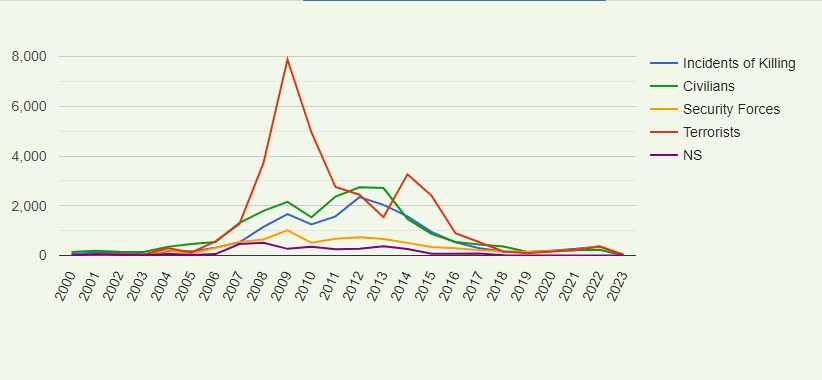
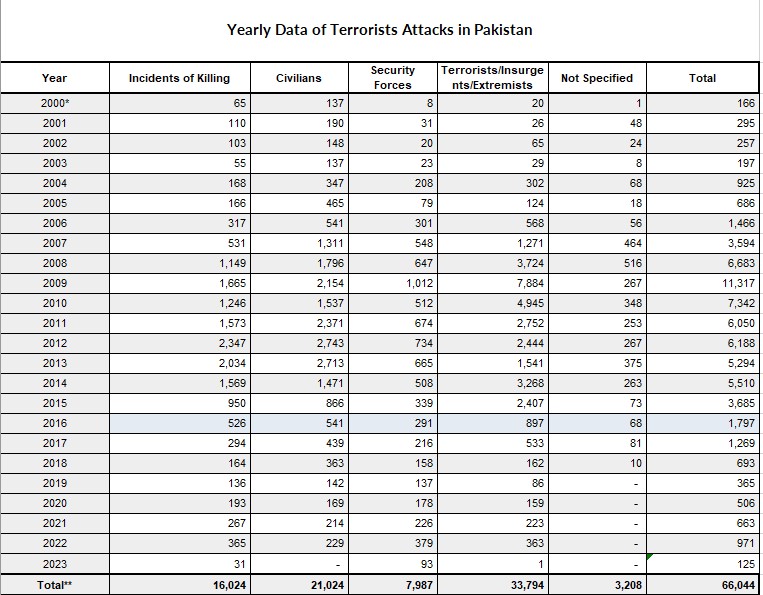
Since 2000, thousands of Pakistanis have perished at the hands of terrorism. According to the data, 66،044 security personnel and civilians have lost their lives in 16,024 terrorist attacks.
How to Combat Suicide Terrorism
Several defensive and offensive elements must be used to combat suicide terrorism. To reduce the long-term motivation for such attacks, the grievances that give rise to terrorism must be addressed concurrently. Law enforcement, public mobilization, domestic and international cooperation, and consequence management, among other steps, are critical components of a national strategy to counter suicide terrorism that a government must employ simultaneously. The role of intelligence is critical in preventing suicide terrorism from occurring in the first place.
