
Close Menu
    • Home
    • Pakistan
      • Balochistan
      • Khyber Pakhtunkhwa
    • Afghanistan
    • Iran
    • Middle East
    • Opinions
    Facebook X (Twitter) Instagram
    Facebook X (Twitter) Instagram YouTube
    Counter Terrorism Blog | Ground Zero
    Subscribe
    • Home
    • Pakistan
      • Balochistan
      • Khyber Pakhtunkhwa
    • Afghanistan
    • Iran
    • Middle East
    • Opinions
    Counter Terrorism Blog | Ground Zero
    Home » Shifting Stories and Staged Optics: Questions Rise Over the Kunar Incident Narrative
    Pakistan

    Shifting Stories and Staged Optics: Questions Rise Over the Kunar Incident Narrative

    Web Desk2By Web Desk2April 28, 2026No Comments2 Mins Read
    Shifting Stories and Staged Optics: Questions Rise Over the Kunar Incident Narrative
    Share
    Facebook Twitter Email Copy Link WhatsApp

    The Afghan Kharji regime carries a long and troubling record marked by betrayal, violence and the instrumental use of religion to shape narratives for strategic gain. Time and again, it has relied on victimhood as a shield while pursuing objectives that often disregard the very people it claims to represent.

    For this ruling clique, human lives appear secondary to political messaging. Outcomes are pursued even if it means placing its own population in harm’s way. This pattern has fueled skepticism toward recent claims emerging from Afghanistan, particularly regarding the so-called Kunar strikes.

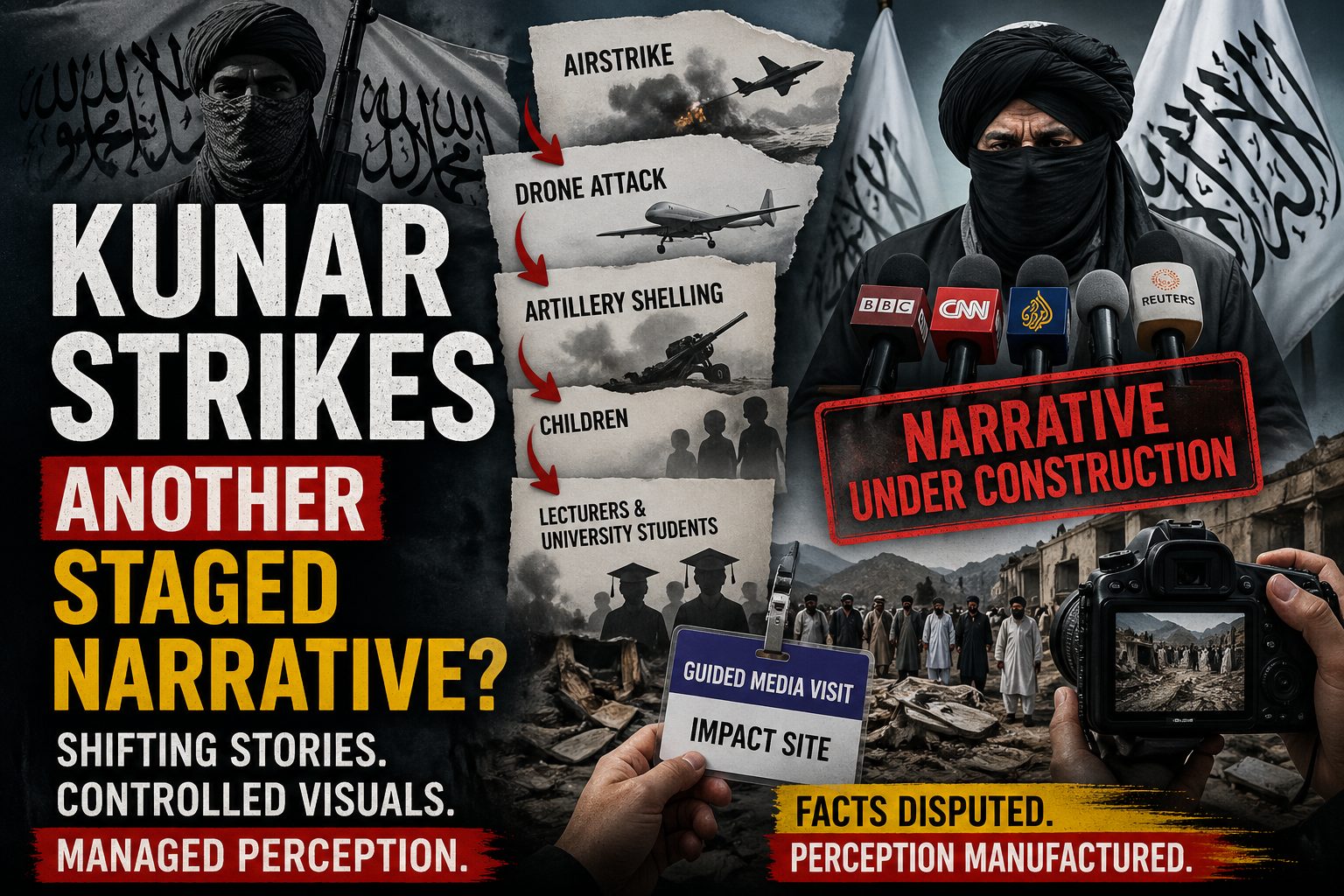
    What unfolded around Kunar reflects a familiar pattern of narrative instability. Initial reports described an airstrike. Soon after, the story shifted to a drone attack, followed later by claims of artillery shelling. The portrayal of casualties also evolved, first described as children and later reframed as lecturers and university students. Such shifting accounts often raise questions about credibility and point toward the possibility of a constructed narrative rather than a verified sequence of events.

    Further concerns arise from reports that authorities are arranging a guided media visit to what is being presented as an “impact site.” Comparisons are being drawn to past staged scenarios where access, visuals and testimonies are tightly controlled. In such cases, the issue is not the presence of journalists but the conditions under which information is curated and presented.

    This approach appears less about transparency and more about shaping perception. Controlled imagery, selective exposure and pre-arranged narratives can create the illusion of authenticity, even when underlying facts remain disputed. Carefully managed scenes, rehearsed accounts and symbolic visuals often play a central role in influencing how such incidents are understood internationally.

    Adding to the complexity is the apparent contradiction in messaging. A regime that claims religious legitimacy now appears to rely on amplification from a diverse range of external voices, including those with their own political agendas. This convergence raises further questions about the motivations behind the narrative and the extent to which it is being shaped beyond Afghanistan’s borders.

    At its core, the Kunar episode highlights the broader challenge of information warfare in the modern era. Competing narratives, rapid dissemination and selective framing make it increasingly difficult to separate fact from fabrication. What is emerging in this case appears less like an objective account of events and more like an effort to build a storyline first and align evidence afterward.

    Afghan Taliban Afghanistan false flag Geopolitics Kunar Media Manipulation Misinformation Narrative Warfare Pakistan Security propaganda Top Story
    Follow on Flipboard Follow on Facebook Follow on X (Twitter) Follow on Instagram Follow on WhatsApp
    Share. Facebook Twitter Email Copy Link WhatsApp
    Web Desk2
    • Website

    Related Posts

    EU and ASEAN Call for Peaceful Resolution in US–Iran Tensions

    April 28, 2026

    Pakistan Successfully Tests Indigenous Fateh-II Missile, Reinforcing Precision Strike Capabilities

    April 28, 2026

    Emerging Afghan Voices Call for Recognition of Durand Line as Settled International Border

    April 28, 2026

    US–Israel–Iran Confrontation and Pakistan’s Maritime Strategic Balancing in a Shifting Global Order

    April 28, 2026

    Bara Operation Sparks Controversy as Security Crackdown Meets Political Protest in Peshawar

    April 28, 2026

    Top Pakistani Clerics Declare Armed Rebellion and Misuse of Jihad Against the State Un-Islamic

    April 28, 2026
    Add A Comment
    Leave A Reply Cancel Reply

    GZ YouTube Channel
    Ground Zero YouTube
    Editors Picks

    EU and ASEAN Call for Peaceful Resolution in US–Iran Tensions

    April 28, 2026

    Pakistan Successfully Tests Indigenous Fateh-II Missile, Reinforcing Precision Strike Capabilities

    April 28, 2026

    Emerging Afghan Voices Call for Recognition of Durand Line as Settled International Border

    April 28, 2026

    US–Israel–Iran Confrontation and Pakistan’s Maritime Strategic Balancing in a Shifting Global Order

    April 28, 2026

    Bara Operation Sparks Controversy as Security Crackdown Meets Political Protest in Peshawar

    April 28, 2026
    Facebook X (Twitter) Instagram YouTube
    • About Ground Zero
    • Terms of Use
    • Privacy Policy
    • Sitemap
    • Contact Us
    © 2026 Ground Zero. Designed by Khyber Digital.

    Type above and press Enter to search. Press Esc to cancel.