


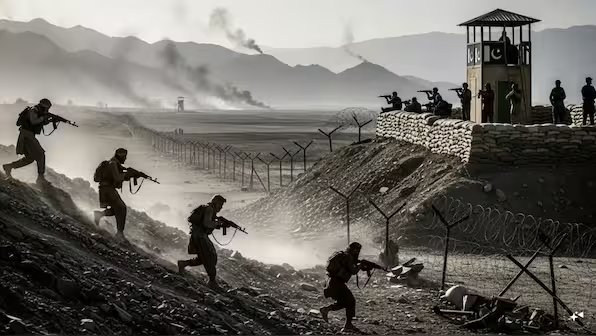
As the United States is reportedly preparing for a renewed phase of operations under Operation Epic Fury, Pakistan continues to conduct sustained counterterrorism actions across the Durand Line inside Afghan territory. Under its own campaign, referred to as Operation Ghazab lil-Haq (“Wrath for Justice”), Islamabad is carrying out precision strikes against Tehrik-e Taliban Pakistan (TTP) sanctuaries and alleged facilitators operating from Afghan soil.
The operation reflects Pakistan’s expanding capacity to respond to cross-border militant threats with targeted military action, emphasizing precision, intelligence-based targeting, and efforts to minimize civilian harm. Officials frame the campaign as limited in scope, focused exclusively on militant networks, and explicitly reject any notion of regime change in Kabul.
According to official assessments, more than 180 militant sites and over 30 staging areas have reportedly been dismantled or neutralized, significantly degrading hostile operational capabilities while maintaining what authorities describe as a restrained approach to collateral damage.
In contrast with broader international operations that have faced criticism over unintended civilian impact, Pakistan’s approach is being presented as “surgical” and intelligence-driven. However, observers note that sustaining military gains alone may not be sufficient to ensure long-term stability in the region.
Strategic analysis of both Epic Fury and Ghazab lil-Haq highlights a broader lesson in modern conflict: military force, even when precise and effective, cannot independently achieve lasting political outcomes. Durable peace, experts argue, requires a coordinated blend of military pressure, diplomatic engagement, economic measures, and governance reform.
Islamabad’s operational narrative has been carefully constructed around the principles of limited engagement and controlled escalation. Officials emphasize that operations are directed solely at militant infrastructure and avoid civilian population centers to preserve legitimacy and maintain public trust. The messaging also underscores respect for Afghan sovereignty, framing actions as defensive responses rather than expansionist intent.
At the same time, Pakistan is reportedly working to disrupt the structural ecosystem that enables militancy, including porous border controls, illicit trade routes, and governance gaps. Strengthening border management and improving coordination with regional actors are seen as key pillars of this broader strategy.
Equally important, Islamabad continues to stress that Afghanistan’s political future is a matter for Afghans themselves, signaling an attempt to balance security imperatives with diplomatic restraint. Authorities also highlight the importance of integrating civilian institutions, local communities, and regional frameworks into counterterrorism efforts to ensure long-term resilience.
The evolving doctrine, as described by officials, reflects a coordinated civil-military approach in which the professionalism of the armed forces creates space for diplomacy and governance mechanisms to operate effectively. This stands in contrast to critiques of past U.S. campaigns in Afghanistan and Iraq, where military dominance was often seen as overshadowing diplomatic and civilian decision-making structures.
Ultimately, Pakistan’s approach suggests an attempt to translate tactical battlefield gains into broader strategic stability through a combination of precision military action and sustained political and institutional engagement.
