

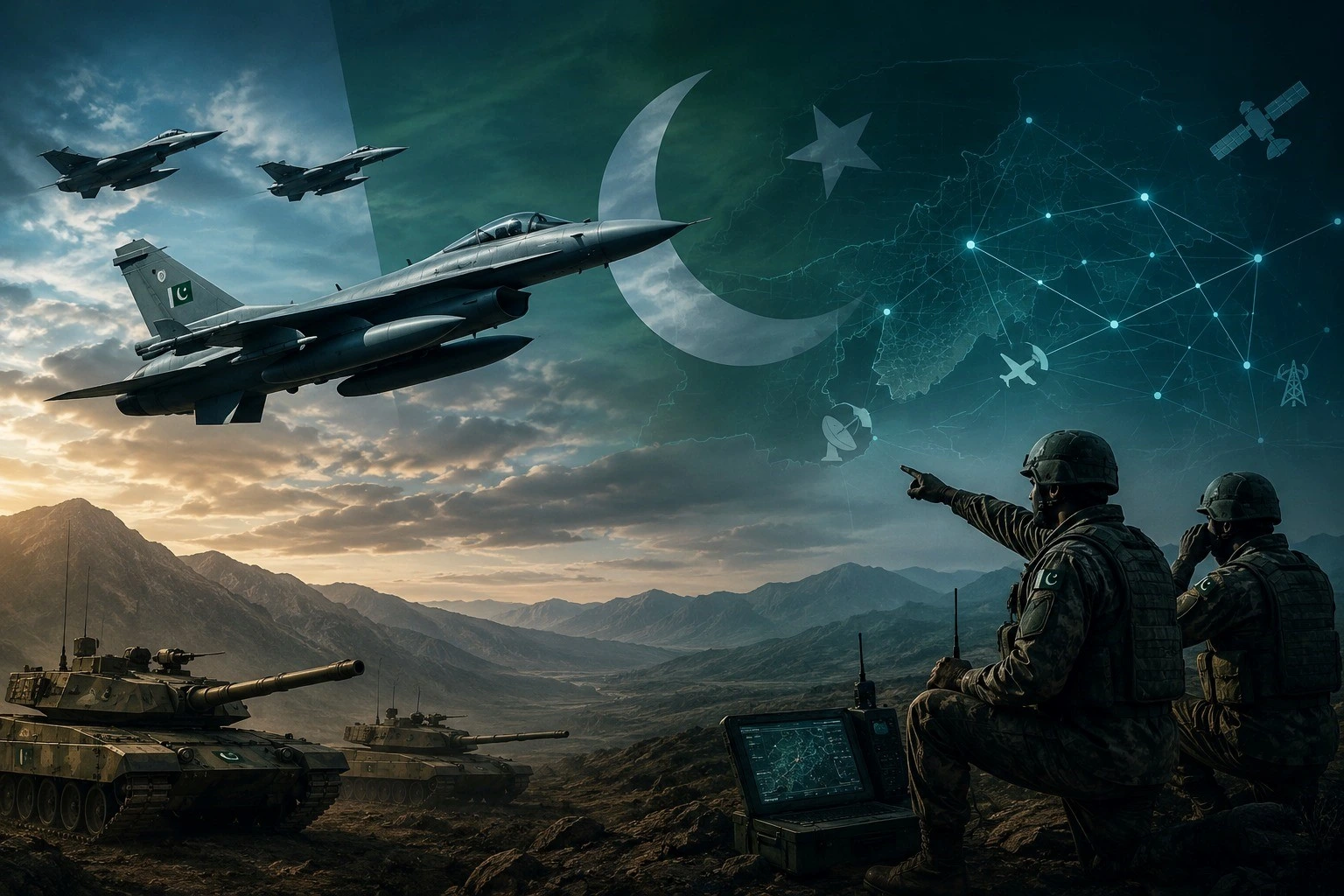
Modern warfare is no longer fought by isolated military branches operating independently. Success on the battlefield now depends on coordination, integration, and the ability of different services to function as a unified force. This concept has long been emphasized by military strategists around the world.
Former US President and military commander Dwight D. Eisenhower once stated, “Separate ground, sea, and air warfare is gone forever. If ever again we should be involved in war, we will fight it in all elements, with all services, as one single concentrated effort.”
This reality was powerfully demonstrated during Marka-e-Haq in May 2025, when the Pakistan Air Force (PAF) and Pakistan Army displayed an advanced level of interoperability that became one of the defining features of the conflict.
Interoperability within Pakistan’s Armed Forces is not a recent development. During the 1965 and 1971 wars against India, the Pakistan Army and the PAF frequently operated in coordination to achieve shared military objectives. However, this cooperation was formally institutionalized in 1976 with the establishment of the Joint Chiefs of Staff Committee (JCSC). The committee was designed to streamline coordination among the services and provide unified military advice to the government.
Over the decades, interoperability has further strengthened through regular tri-service military exercises, cross-service officer training, and coordinated strategic planning. These long-term efforts created the operational foundation that became clearly visible during Marka-e-Haq in May 2025.
The conflict marked the first major instance where the PAF and Pakistan Army operated under a partially shared situational awareness framework supported by temporary liaison nodes and parallel data-sharing systems under joint oversight. The first major demonstration of this coordination came on 8 May 2025, after India turned toward drone warfare following significant losses suffered by the Indian Air Force (IAF).
During the night of 6-7 May, under the leadership of Air Chief Marshal Zaheer Ahmed Baber Sidhu, the PAF reportedly shot down seven Indian fighter aircraft along with a Heron UAV. Following these losses, the IAF reduced its aerial operations, prompting India to deploy over one hundred Israeli-made Harop drones against Pakistan on the morning of 8 May.
Pakistan responded with a highly coordinated air defense operation. The PAF Air Defence Command worked closely with Pakistan Army defense units to intercept and destroy nearly all incoming drones. The PAF utilized cyber and space-based assets alongside conventional air defense systems, while the Army contributed ground-based defensive support to neutralize UAVs entering Pakistani airspace.
After failing to achieve success through drone attacks, India escalated the conflict further by launching BrahMos missile strikes targeting PAF airbases during the night of 9 and 10 May. The strikes crossed what Pakistan considered a strategic red line and triggered a full-scale retaliatory operation known as Bunyan-ul-Marsoos.
In response, the PAF and Pakistan Army executed coordinated retaliatory strikes in one of the most significant displays of joint warfare in Pakistan’s modern military history. The operation combined PAF air assets with Fatah-1 and Fatah-2 short-range ballistic missile systems. The strikes reportedly targeted at least eighteen Indian airbases, command and control centers, BrahMos storage facilities, S-400 air defense batteries, brigade headquarters, intelligence facilities, and multiple field supply depots.
The intensity and precision of these retaliatory operations reportedly forced India to seek a ceasefire through US mediation on 10 May 2025, bringing an end to what many analysts now describe as the “Four-Day War.”
The conflict also highlighted the growing importance of integrated military structures in South Asia. India has already begun adjusting its military doctrine through initiatives such as Defence Forces Vision 2047, which focuses on integrated theatre commands and deeper inter-service coordination.
Pakistan, however, has also accelerated efforts to strengthen military integration. One major step was the establishment of the office of the Chief of Defence Forces in December 2025, aimed at creating a more unified command structure among the armed services. Additionally, all three services have reportedly shown increased commitment toward joint exercises, integrated command planning, and operational coordination following the lessons learned during Marka-e-Haq.
Ultimately, Marka-e-Haq represented more than just a battlefield victory or a successful military response. It demonstrated the evolution of Pakistan’s joint warfighting doctrine and showcased how integrated operations between the PAF and Pakistan Army have matured under real combat conditions. More importantly, the conflict reinforced Pakistan’s ability to anticipate, counter, and pre-empt future military challenges through coordinated force projection and strategic interoperability.