


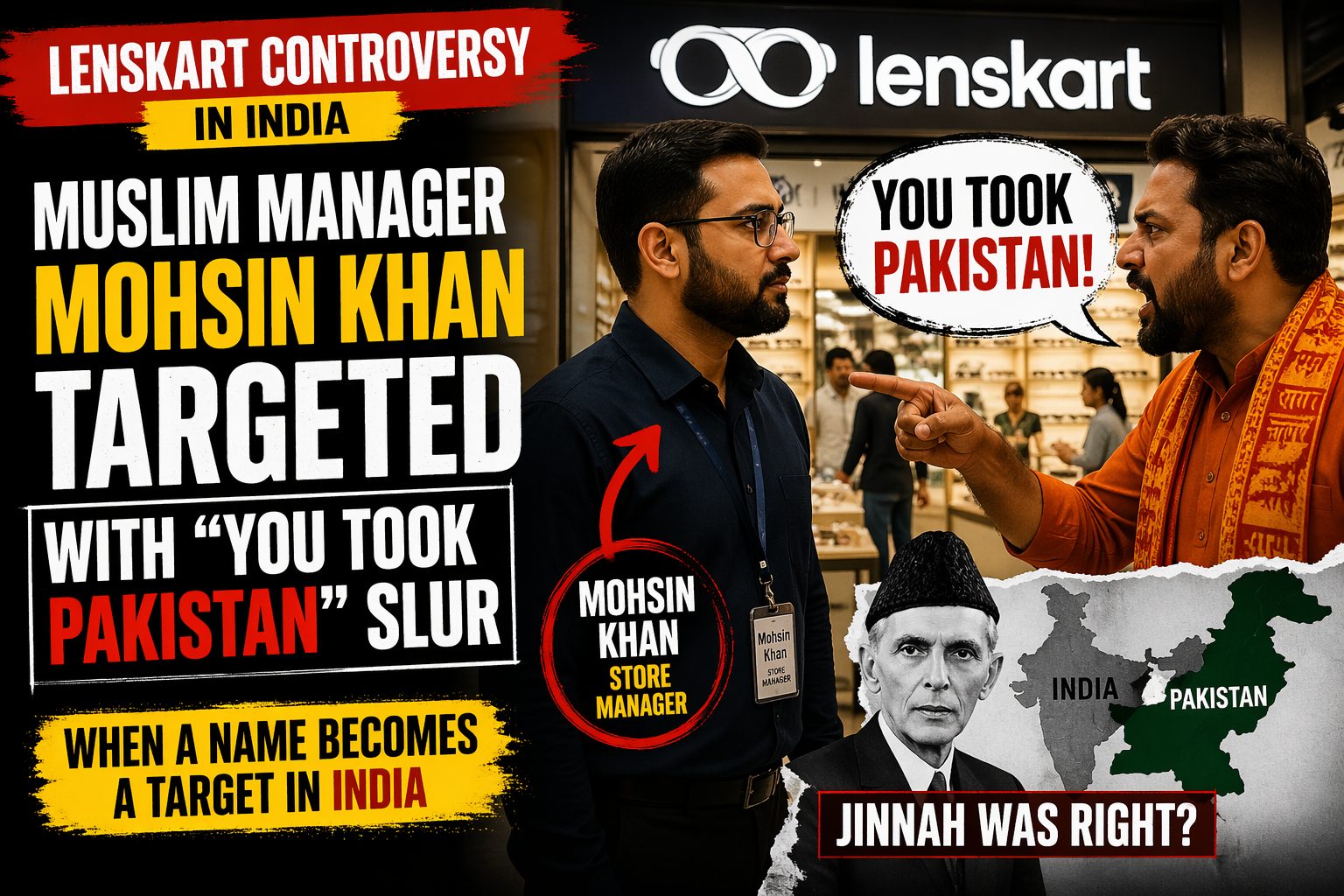
The recent confrontation at a Lenskart outlet exposes a troubling reality where individual Muslim professionals are made to bear the weight of grievances far beyond their control. In an increasingly polarized environment shaped by the politics of Narendra Modi, a store manager, Mohsin Khan, found himself publicly targeted not for his role, but for his identity.
A political activist aggressively questioned and accused him of attempting to impose “Sharia law,” merely because he held a position of authority within a workplace governed by corporate policies. The situation escalated further when symbolic religious markers were invoked, with allegations that the company’s dress code favored the hijab over other expressions such as the tilak or kalawa. What should have remained a discussion about workplace rules was instead turned into a charged communal confrontation.
The rhetoric directed at Mohsin Khan was deeply personal and exclusionary. Statements such as “You are Mohsin Khan, so you’ll turn everyone into Mohsin Khan?” and references to historical divisions, including the claim that “Muslims already took Pakistan,” reflect how quickly professional spaces can be transformed into arenas of ideological hostility. By personalizing a corporate policy and projecting it onto one individual, the activist reframed a routine workplace matter into a symbol of religious and geopolitical tension.
This incident highlights the fragile position of Muslim employees, where their names, identities, and roles can be weaponized against them. When a manager is questioned about his authority through the lens of religion, and accused of representing a broader agenda, the workplace ceases to function as a neutral, professional environment. Instead, it becomes a stage for targeted scrutiny and intimidation.
In many ways, such episodes echo the concerns raised by Muhammad Ali Jinnah, whose articulation of the Two-Nation Theory anticipated deep-rooted communal divides. The existence of Pakistan stands as a reminder of that historical context, where identity and belonging were central to the political discourse. Incidents like these reinforce the argument that for many, a person’s name should never become a trigger for suspicion, but rather remain a simple reflection of individual identity and rightful place in society.
