

In international relations, there are no permanent friends or enemies, only permanent interests. John Mearsheimer’s theory of offensive realism underscores a harsh truth: capabilities matter more than intentions. Today’s strategic partner can quickly evolve into tomorrow’s adversary, and it is military capability, not diplomatic rhetoric, that ultimately defines this transformation.
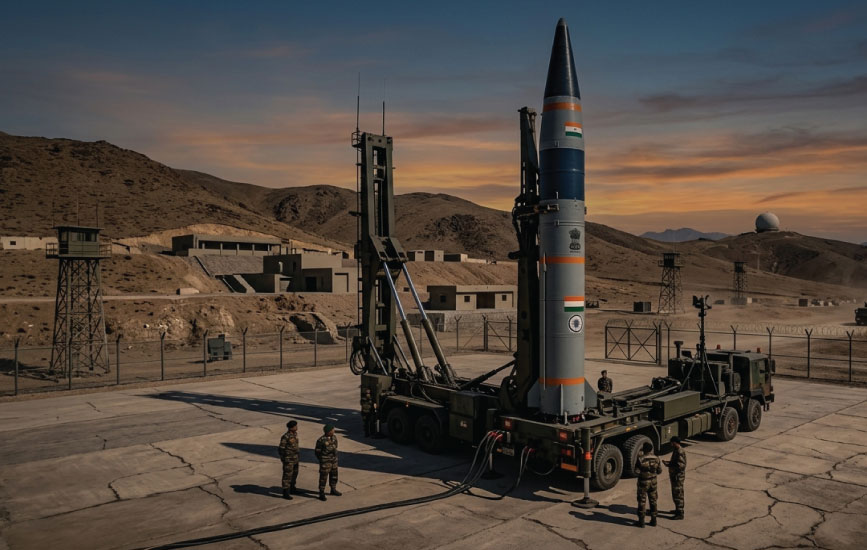
This reality is now unfolding through India’s Defence Research and Development Organization and its latest push for the Agni-VI missile. The Agni-VI is projected to be a four-stage intercontinental ballistic missile equipped with MIRV and MaRV technology, with a reported range of 10,000 to 12,000 kilometers. Such capability extends far beyond regional deterrence, bringing not only China and the Middle East but also Europe, the United States, and Canada within its strike range. This fundamentally alters India’s nuclear posture, shifting it from a regional actor to a potential global destabilizer.
However, the concern is not limited to range alone. The deeper issue lies in institutional reliability. India’s command and control systems have already demonstrated alarming vulnerabilities. In March 2022, a nuclear-capable BrahMos missile was accidentally fired into Pakistani territory. This was followed in March 2023 by the misfiring of three surface-to-air missiles during exercises near the Pakistan border. These incidents raise serious concerns about procedural discipline and operational control.
When such lapses are viewed in the context of a next-generation ICBM, the implications become far more dangerous. If short-range systems cannot be managed effectively, the deployment of a MIRV-capable, THAAD-penetrating missile introduces a high-risk environment where even a minor technical error could trigger catastrophic escalation on a global scale.
The risks are further compounded by repeated incidents of nuclear material theft and trafficking. Data compiled by the South Asia Strategic Stability Institute highlights multiple cases between 1994 and 2021 involving the loss or theft of significant quantities of nuclear material in India. Additional incidents reported in recent years reinforce concerns that a black market network may be taking shape. This raises fundamental questions about nuclear security and accountability.
Global watchdogs have also taken note. The Nuclear Threat Initiative has ranked India below the median on key nuclear security indicators, while the Stockholm International Peace Research Institute continues to document the steady expansion and diversification of nuclear arsenals, including India’s growing focus on long-range delivery systems. As capabilities expand, the consequences of any failure extend far beyond South Asia.
Parallel to these technical and institutional concerns is a troubling shift in India’s political and ideological discourse. The growing influence of Hindutva-driven narratives has introduced a more aggressive and less restrained nuclear posture. This shift has been reflected in statements by Narendra Modi, including rhetoric following the Balakot crisis that hinted at nuclear signaling. Such statements blur the line between deterrence and provocation.
This rhetoric has extended beyond official channels. Gagan Deep Bakshi, in televised remarks, has openly threatened nuclear strikes against major global cities, including New York and Washington, while also suggesting the use of nuclear weapons against any country imposing sanctions on India. Such statements amplify concerns about strategic recklessness and the normalization of nuclear brinkmanship.
The geopolitical environment has further complicated matters. Following the 2025 crisis, tensions between India and the United States have shown signs of strain, particularly over mediation efforts and economic disagreements. In this context, the development of Agni-VI is increasingly being framed domestically as a symbol of strategic autonomy and power projection, even if it comes at the cost of global stability.
The implications are profound. The development of Agni-VI would transform India’s deterrence posture from regionally focused to globally assertive, placing major powers within direct range. As Mearsheimer’s framework suggests, the United States cannot ignore capabilities simply because of current alignment. A partner with the ability to strike globally inevitably becomes a potential threat.
India’s track record of technical lapses, combined with concerns over nuclear material security and increasingly aggressive rhetoric, creates a dangerous equation. The move toward a global-range ICBM, under such conditions, is not merely a strategic upgrade. It is a step toward systemic instability.
Ignoring this trajectory would mean ignoring a growing reality: a state marked by operational vulnerabilities and ideological volatility is moving toward capabilities that can threaten global annihilation. The international community can no longer afford to treat India’s nuclear ambitions as a regional issue. With Agni-VI, it has already crossed into a global concern.