

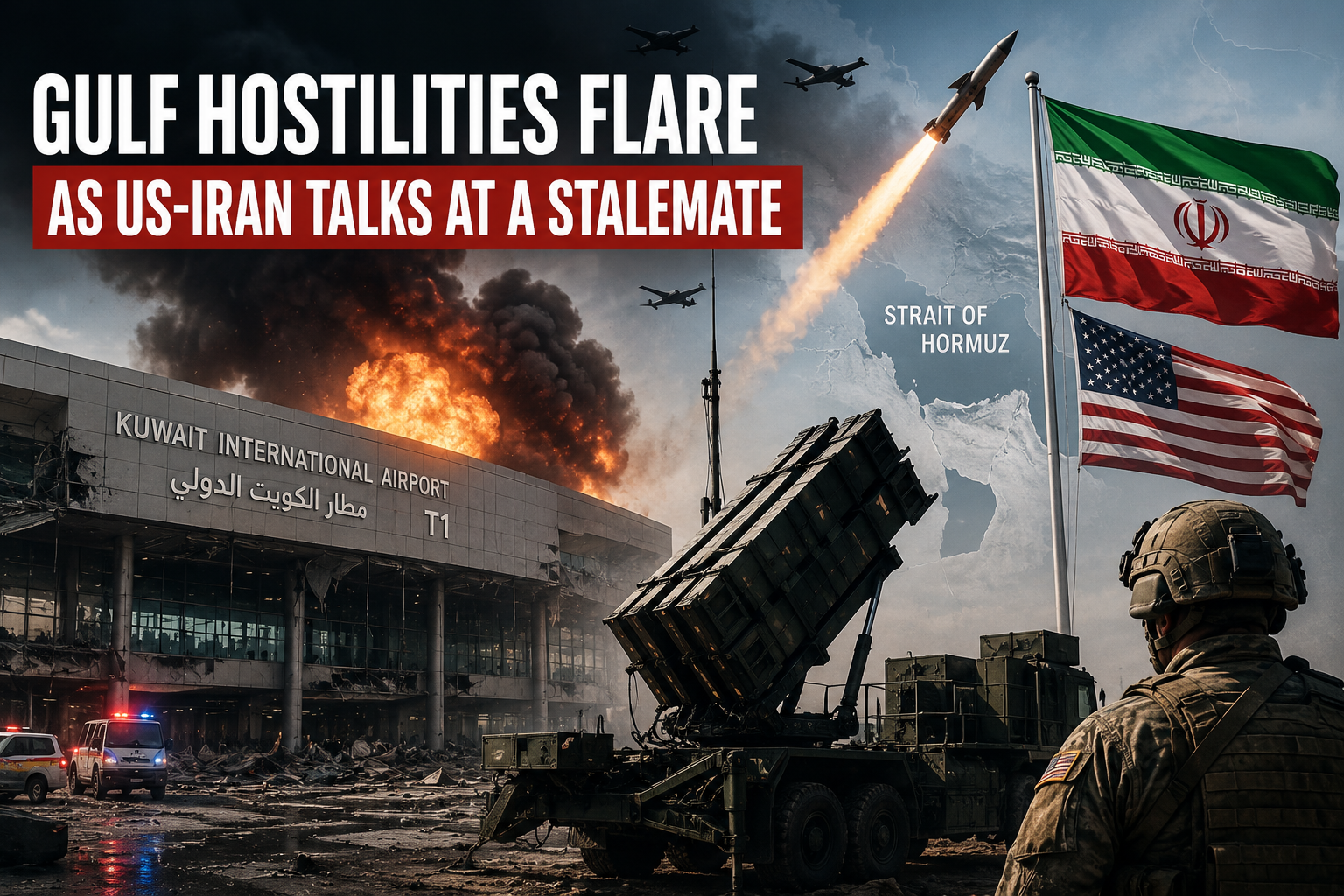
Gulf Hostilities Escalate as US-Iran Talks Remain Deadlocked
Missile Attack on Kuwait Airport Raises Regional Tensions
Hostilities in the Gulf region intensified on Wednesday after a missile and drone attack damaged Kuwait International Airport, while US forces carried out military strikes near the Strait of Hormuz. The developments come as diplomatic efforts between the United States and Iran remain stalled.
According to Kuwaiti authorities, the attack targeted Terminal 1 of Kuwait International Airport, causing injuries and significant damage to airport facilities. Flight operations were suspended, and incoming flights were diverted until further notice.
Kuwait’s Ministry of Defence condemned the incident, describing it as a serious act of aggression that resulted in both casualties and infrastructure damage.
US Military Responds to Iranian Attacks
The US Central Command reported that several Iranian missiles launched toward regional targets either failed, fell short, or were intercepted. Three ballistic missiles aimed at Bahrain were successfully intercepted, while US forces also neutralized drones targeting civilian vessels and military installations in the Gulf.
In response to attempted attacks, US forces conducted strikes on targets near Qeshm Island, a strategically important location close to the Strait of Hormuz.
US officials stated that military assets in the region remain prepared to respond to any further threats.
Iran Claims Retaliatory Operations
Iranian state media reported that the Islamic Revolutionary Guard Corps (IRGC) launched missile and drone attacks against military targets linked to the United States in the Gulf region. Tehran said the operations were a response to alleged US strikes on Iranian facilities near Qeshm.
Iran also accused Kuwait and Bahrain of supporting US military activities, claiming their territories had been used in operations against Iran.
The Iranian Foreign Ministry stated that Tehran reserves the right to defend itself and respond to future attacks if necessary.
Strait of Hormuz Remains a Major Flashpoint
The Strait of Hormuz continues to be one of the most critical areas in the ongoing crisis. The waterway is a vital route for global energy supplies and previously handled nearly one-fifth of the world’s oil and liquefied natural gas shipments.
Iranian media reported that the IRGC Navy targeted a vessel near Hormuz following what it described as a US attack on an Iranian tanker. Iranian officials warned that any disruption to the security of the strait could have significant consequences for regional stability.
The latest escalation pushed global oil prices higher, reflecting growing concerns about energy supply disruptions.
US-Iran Negotiations Show Little Progress
Despite reports of a tentative ceasefire understanding reached last week, Washington and Tehran have yet to finalize a formal agreement.
Iranian media claimed communication between both sides has slowed in recent days. However, US President Donald Trump stated that discussions continue and that contact between negotiators has remained ongoing.
Diplomatic efforts are focused on ending the conflict and addressing long-standing disagreements over Iran’s nuclear programme.
Nuclear Programme Remains Key Obstacle
The future of Iran’s nuclear activities remains a central issue in negotiations. The United States continues to demand restrictions on Iran’s nuclear programme in exchange for sanctions relief.
Iran insists its nuclear programme is intended for peaceful purposes and denies seeking nuclear weapons. Tehran is also seeking access to frozen oil revenues, relief from economic sanctions, and the removal of restrictions affecting its exports and maritime activities.
US Secretary of State Marco Rubio reiterated that sanctions relief would depend on Iran agreeing to limit its nuclear activities.
Israel Continues Operations in Lebanon
Meanwhile, tensions remain high in Lebanon despite a US-mediated ceasefire announced earlier this week.
Lebanese security sources reported continued Israeli strikes in several southern areas, while surveillance drones remained active over Beirut. The situation has heightened concerns among civilians, many of whom remain displaced due to months of conflict.
The broader regional conflict, which began earlier this year, has caused significant casualties, displaced millions, and contributed to rising energy prices and economic uncertainty across the Middle East.
Regional Stability Remains Uncertain
With military exchanges continuing, the Strait of Hormuz under pressure, and nuclear negotiations making little progress, uncertainty remains high across the Gulf region.
Diplomatic efforts continue, but the latest escalation highlights the fragile nature of the ceasefire and the challenges facing any long-term agreement between the United States and Iran.