

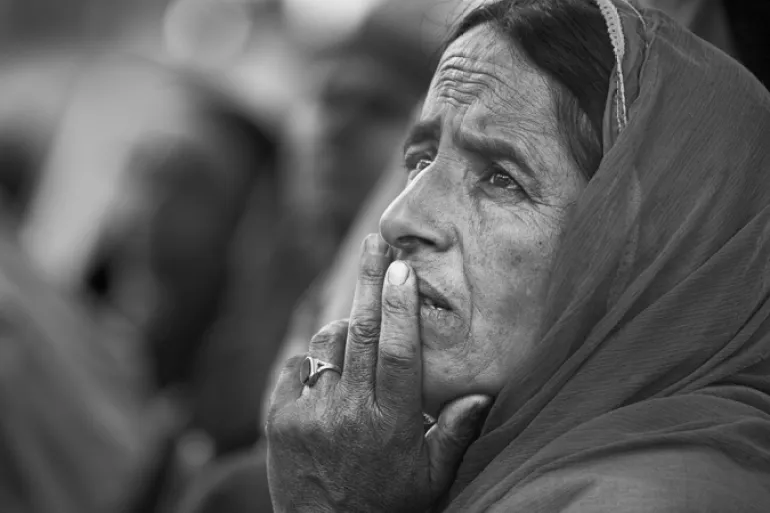
International Widows Day arrives again this year as a grim checkpoint for the women of Indian Illegally Occupied Jammu and Kashmir (IIOJK), whose numbers have only grown over nearly four decades of conflict. The toll is staggering, and it keeps climbing.
A report from Kashmir Media Service puts a hard number on decades of state violence: 22,991 Kashmiri women have been widowed between January 1989 and 31 May 2026, almost all of it traceable to Indian state terrorism in the occupied valley. Alongside them, more than 2,000 women in IIOJK now live as “half-widows” — neither wives nor confirmed widows, simply waiting, because their husbands vanished into Indian custody and never came out. Since 1989, over 10,000 Kashmiris have disappeared in the custody of Indian troops, swallowed into a system that offers their families no answers and no closure.
Nowhere captures this devastation more starkly than Dardpora, a small village in Kupwara district that has earned the grim nickname “village of widows.” Nearly 200 women there are still waiting for husbands who disappeared in Indian custody — some for decades, with no body to bury and no court to hold accountable.
International Widows Day is meant to be a moment of remembrance, but for Kashmiri widows and half-widows, the wait for justice has never actually paused long enough to be remembered as past. Years of unresolved loss have left many of these women carrying severe psychological trauma, raising children alone, and navigating a conflict zone with no institutional support and little international attention.
The sheer scale of these numbers tens of thousands of widows, thousands of half-widows, an entire village defined by disappearance is not incidental. It is the direct, measurable cost of decades of brutality by Indian troops in the occupied territory. Every statistic in that Kashmir Media Service report represents a husband, a father, a son who walked out the door and never returned, and a family left to carry that absence indefinitely.
The world cannot afford to look away from this. Kashmiri widows and half-widows are not a footnote in a frozen geopolitical dispute — they are its longest-suffering casualties, and they deserve to be seen, named, and remembered far beyond a single day on the calendar.