

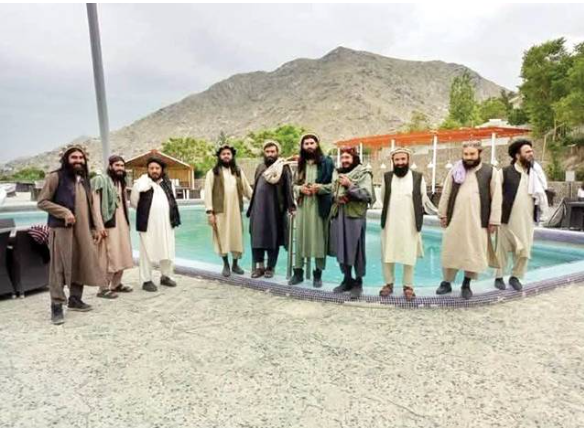
Some evidence speaks for itself. It needs no spin room, no diplomatic cable, no painstaking cross-reference with UN documentation. A photograph does the job on its own. Senior commanders of the Hafiz Gul Bahadur Group a terrorist outfit with Pakistani soldiers’ and civilians’ blood on its hands have been pictured lounging at the swimming pool of Kabul’s five-star InterContinental Hotel.
Sadr Hayat alias Abu Sufyan, Commander Jalali, Commander Rehbar Waziristani, Commander Ghazi, and other senior figures of this banned network are not hunched in some remote mountain hideout. They are poolside, in plain sight, in the heart of the Afghan capital.
This image needs no annotation. It is a direct visual rebuttal to every Taliban assurance that Afghan territory is not being used against its neighbors, that terror outfits enjoy no sanctuary under their rule, and that warnings from Pakistan, the UN, and a growing list of international observers are nothing but political noise. The photo gives a face to what UN Security Council Monitoring Team reports have been describing in careful diplomatic language. It turns phrases like “safe haven” and “operational freedom” into something far less abstract: a hotel lobby, a swimming pool, a timestamp.
Here is the plain truth: no designated terrorist commander gets five-star accommodation and free movement through a capital city without the protection, facilitation, or at minimum the deliberate look-the-other-way of whoever actually controls that territory. This isn’t speculation — it’s how sanctuary works anywhere in the world. The Taliban run Afghanistan. They run Kabul. They run the administrative and security machinery that decides who moves freely and who doesn’t in their own capital. So when Gul Bahadur Group commanders are found relaxing at the InterContinental, that isn’t some accident slipping past Taliban control — it is Taliban governance, functioning exactly as intended.
For four years, despite 225 border flag meetings, 836 formal protest notes, 13 demarches, and Pakistan’s repeated identification of more than five dozen TTP camps on Afghan soil, the Taliban have insisted that no terror groups operate freely from their territory — and that Pakistan’s security troubles are entirely homegrown. This photograph answers that claim better than any press release ever could. Sadr Hayat and company are not Islamabad’s internal problem. They’re in Kabul. At a hotel. In public. Untouched.
And this image doesn’t stand alone — it fits a pattern the international monitoring community has been documenting for years. The UN’s 16th Security Council Monitoring Team report flagged over twenty terrorist groups and up to 13,000 foreign fighters operating out of Afghanistan. The 37th report noted a rise in cross-border attacks launched from Afghan soil, and assessed that TTP now enjoys greater operational space under Taliban rule. SIGAR has cited figures of 6,000 to 6,500 TTP fighters alongside senior Al-Qaeda leadership present inside the country. Even Russia has acknowledged TTP’s central role in fueling Afghanistan-Pakistan tensions at the UNSC. Not a single UN member state has bought the Taliban’s denials.
Worth naming too: the Taliban’s apologists in Western policy circles, Zalmay Khalilzad chief among them — the same man whose Doha Agreement explicitly obligated the Taliban to deny Afghan soil to terrorist groups, and who now spends more energy scrutinizing Pakistan than holding the Taliban to that promise. The argument that terrorism inside Pakistan is purely a domestic failure, with zero accountability for the Afghan territory these networks freely use to train, recruit, and plan, has found a comfortable home in parts of Western commentary. This photograph makes that argument considerably harder to sell. It’s not easy to call this Pakistan’s internal failure when the commanders in question are sipping poolside drinks in Kabul.
What this image ultimately captures is what’s happened to Kabul since August 2021 — a transformation from a national capital into the operational nerve center of a regional terror network. Under Taliban rule, the city has become a haven, a rendezvous point, and a logistics hub for anti-Pakistan terrorist franchises that have killed Pakistani soldiers and civilians without pause. The Taliban are not bystanders to any of this. They are the architects, the facilitators — and, as this photograph proves beyond doubt, the hosts.