

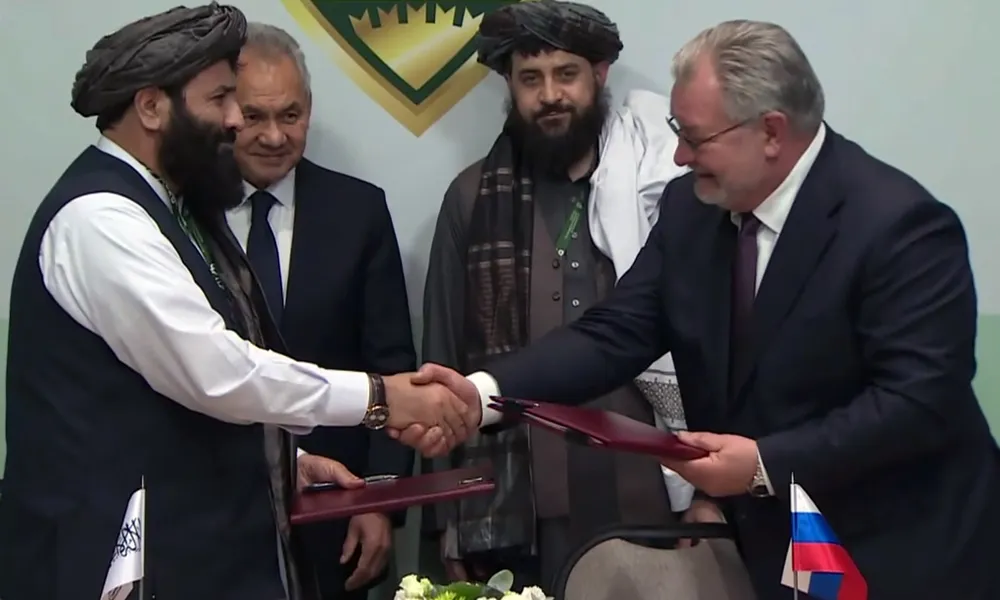
Russia’s expanding military engagement with the Taliban regime has opened a new and complex chapter in Eurasian geopolitics, but it is also exposing a deeper contradiction that cannot be ignored. While Moscow publicly positions itself as a stakeholder in global counterterrorism, its growing defense cooperation with the Taliban-controlled administration in Afghanistan raises serious questions about strategic consistency and regional security consequences.
The core issue is not diplomacy itself, but the environment in which this diplomacy is unfolding. Afghanistan under Taliban rule has not stabilized in the way many international actors had hoped. Instead, it has increasingly been associated with the operational space of the Tehrik-i-Taliban Pakistan (TTP), an organization responsible for sustained cross-border attacks inside Pakistan. The persistence of these networks creates a reality that cannot be dismissed through political engagement alone.
Reports from international monitoring bodies, including United Nations tracking mechanisms, have repeatedly highlighted concerns regarding militant mobility and logistical space in Afghanistan. Within this context, the expansion of Russia-Taliban defense cooperation appears strategically misaligned with the ground realities of South Asia’s security environment. The concern is not abstract. It is directly tied to the operational capability of groups that have intensified violence across Pakistan’s border regions.
Pakistan continues to face the consequences of this evolving threat landscape. Security forces and civilians have borne the brunt of sustained attacks originating from militant sanctuaries that benefit from porous oversight in Afghanistan. The issue is not limited to isolated incidents but reflects a broader pattern of cross-border militancy that has become one of the most persistent challenges for regional stability.
What makes the current geopolitical shift particularly significant is the contradiction in external narratives. On one hand, global powers including Russia emphasize the dangers of transnational terrorism and instability emanating from Afghanistan. On the other hand, increasing military cooperation with the same governing structure risks legitimizing an environment where militant groups continue to operate with relative freedom.
This duality creates a dangerous strategic gap. It signals a form of selective engagement where geopolitical interests override consistent counterterrorism frameworks. The long-term risk is not only the empowerment of existing militant networks but also the normalization of their operational ecosystems under state-like recognition.
For Pakistan, the implications are immediate and tangible. The country remains at the frontline of this security challenge, absorbing the human, economic, and strategic costs of regional instability. Any expansion of external engagement with Afghanistan must therefore be evaluated not only through diplomatic optics but through its impact on militant dynamics on the ground.
The broader concern extends beyond bilateral relationships. If Afghanistan continues to function as a permissive environment for groups like the TTP, then the implications will eventually reach beyond South Asia. Central Asia and even Russia’s own security perimeter could face spillover risks from the same networks that are currently being underestimated or selectively addressed.
Regional stability cannot be built on fragmented counterterrorism logic. It requires consistent pressure on all militant structures regardless of political convenience. Without this coherence, partnerships risk becoming accelerants of the very instability they claim to prevent.