

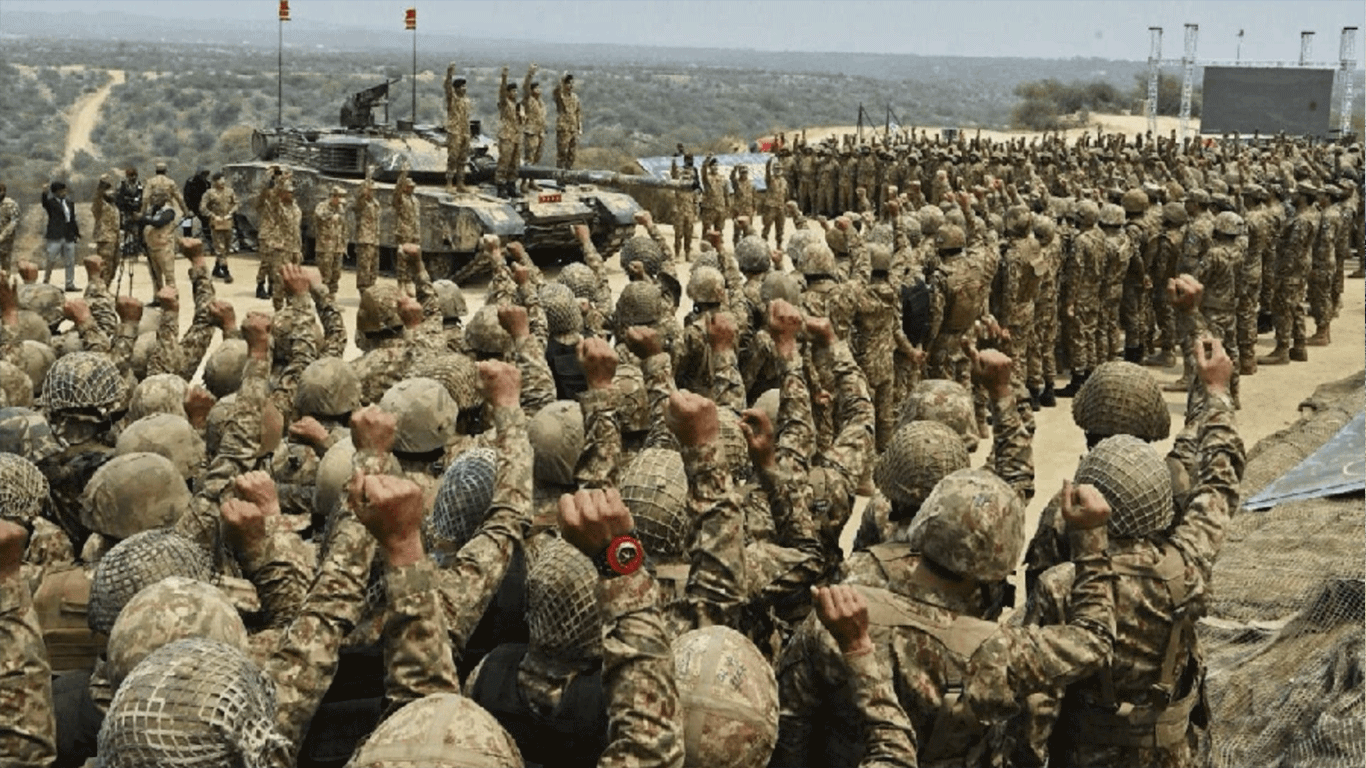
The debate over the ethnic composition of armed forces is not unique to Pakistan. Throughout history, militaries around the world have recruited disproportionately from certain regions, communities, and socio-economic classes due to geography, economic realities, historical traditions, and recruitment patterns. Yet one principle remains constant in every sovereign state: a national military is defined not by the ethnicity of its personnel, but by the state, constitution, and authority it is sworn to defend.
In a recently circulated Facebook video, a speaker claiming to be among the founding figures of the Pashtun Tahaffuz Movement (PTM) argued that the Pakistan Army should not be called the “Pakistan Army” because a large number of its personnel come from Punjab. According to this claim, the institution should instead be viewed through an ethnic lens. Such an argument reflects a flawed understanding of how modern military institutions function. It confuses demographic composition with institutional identity and attempts to reduce a constitutional national force into a provincial or ethnic entity.
The reality is far more nuanced. Recruitment patterns in Pakistan’s armed forces have historically been influenced by socio-economic conditions, particularly in parts of Punjab and Khyber Pakhtunkhwa where agricultural economies, limited industrial opportunities, and long-standing traditions of military service encouraged generations to join the armed forces. These patterns existed long before Pakistan’s creation and were reinforced during the British Indian Army era when certain regions became major recruitment hubs.
At the same time, the claim that the Pakistan Army is exclusively dominated by one ethnic group ignores the diversity present within its ranks and leadership. Pashtun representation in the military has historically been significant, often exceeding their proportion in the national population. Pakistan’s military leadership has included distinguished officers from multiple ethnic and regional backgrounds, including Pashtun officers such as General Ehsan-ul-Haq, Lieutenant General Muhammad Hassan Khattak, and Lieutenant General Shakir Ullah Khattak. Senior commanders have also emerged from Kashmir, including General Muhammad Aziz Khan and Lieutenant General Shahid Imtiaz, as well as from Gilgit-Baltistan, including Lieutenant General Inayat Hussain. Officers and soldiers from Sindh, Balochistan, Punjab, and minority communities have all played vital roles in defending Pakistan and strengthening its institutions.
Historical comparisons with the British Indian Army are also misleading. That force was called “British” because political authority, sovereignty, and command rested with the British Crown, not because of the ethnic composition of its soldiers. Pakistan, by contrast, is a sovereign state, and its military derives legitimacy from the Constitution of Pakistan, the authority of the Pakistani state, and its responsibility to defend the country’s territorial integrity.
International examples further weaken attempts to define militaries through ethnic arithmetic. The United States Army is not described according to the racial majority within its ranks. The British Army is not renamed based on England’s demographic dominance. China’s People’s Liberation Army is not called a “Han Army” despite Han Chinese forming the overwhelming majority of the population. India itself maintains regimental traditions linked to various ethnic and regional communities, yet no serious scholar argues that it is anything other than the military force of the Indian state.
If institutions were renamed according to the largest demographic group within them, the concept of a nation-state itself would collapse. By the same logic, countries and provinces could be reduced to tribal or ethnic identities alone, undermining national cohesion and constitutional order.
This does not mean that discussions about representation, recruitment patterns, diversity, and regional participation are invalid. These are legitimate areas for policy debate and institutional research. A modern democratic state should continue evaluating whether national institutions provide equitable opportunities and reflect the diversity of society. However, such discussions must remain grounded in facts, historical context, and institutional analysis rather than narratives that seek to divide national institutions along ethnic lines.
Pakistan’s strength lies in its diversity. Punjabis, Pashtuns, Sindhis, Baloch, Kashmiris, the people of Gilgit-Baltistan, and religious minorities are all equal stakeholders in the state. Their sons and daughters have served under one flag, and thousands from every region have sacrificed their lives in defence of the country.
The defining identity of a national military does not come from ethnicity. It comes from the state it serves, the Constitution it protects, the flag it salutes, the oath its soldiers take, and the territory it is entrusted to defend.
By that standard, it is not a Punjabi Army, a Pashtun Army, a Sindhi Army, a Baloch Army, or a Kashmiri Army.
It is the Pakistan Army because it belongs to Pakistan.