

In 1904, British geographer and strategist Halford Mackinder introduced a theory that would outlive empires, ideologies, and even the century that produced it. Speaking before the Royal Geographical Society, he argued that the struggle for global power would ultimately revolve around geography, not temporary political systems or shifting alliances. At the centre of his theory stood the “Heartland,” a vast landlocked expanse stretching across Eurasia, protected from maritime dominance and rich in strategic depth.
For decades, many dismissed Mackinder’s ideas as outdated. The rise of air power, nuclear deterrence, cyberspace, and globalisation supposedly made geography less relevant. The modern world, scholars claimed, would be shaped by technology and economics rather than mountains, corridors, ports, and sea routes.
But history has a habit of returning to old truths.
That reality became visible again during a high-level webinar organised in Islamabad on June 9, 2026, by the Institute of Strategic Studies Islamabad (ISSI) in collaboration with the University of World Civilisations. Pakistani and Russian diplomats, policymakers, and analysts gathered to discuss connectivity corridors, Gwadar Port, energy routes, Central Asian access, and emerging Eurasian cooperation.
Nobody explicitly mentioned Mackinder. They did not need to.
The logic of geography already dominated the conversation.
Former diplomats, ministers, and strategists repeatedly referred to access to the Arabian Sea, regional transport corridors, and Pakistan’s role as a bridge between South Asia, Central Asia, Russia, and West Asia. Discussions surrounding the International North-South Transport Corridor (INSTC), CPEC, and wider Eurasian connectivity reflected a reality that modern geopolitics never truly escaped: geography still shapes strategy.
The twentieth century’s major geopolitical theories may appear old, but the problems they attempted to explain remain remarkably familiar.
Mackinder believed the great struggle of world politics centred on Eurasia’s interior. Dutch-American strategist Nicholas Spykman later challenged this idea by arguing that control of the “Rimland,” the coastal belt stretching across Europe, the Middle East, South Asia, and East Asia, mattered more than control of the continental core itself.
The debate between Heartland and Rimland eventually became embedded within Cold War strategy. NATO, American alliances in East Asia, maritime containment policies, and Soviet expansion anxieties all reflected these competing strategic visions.
Then came the post-Cold War period. Globalisation encouraged the belief that geography no longer mattered. Borders became economically porous. Digital networks appeared more important than physical terrain. Strategic thinking increasingly shifted toward economics, trade liberalisation, and interdependence.
But recent events have reversed that illusion.
The Russia-Ukraine war once again exposed the enduring importance of territory, buffers, corridors, and maritime access. Ukraine is not merely a political dispute or a NATO question. It occupies one of the most strategically important spaces in Eurasia, linking the Black Sea, agricultural corridors, and the western approaches to Russia’s historical strategic depth.
At the same time, China’s Belt and Road Initiative (BRI) represents perhaps the largest modern attempt to reshape geography through infrastructure. Beijing’s investments across Central Asia, Pakistan, Southeast Asia, and the Indian Ocean are not random development projects. They are efforts to secure overland connectivity, diversify trade routes, and reduce vulnerability to maritime chokepoints dominated by rival powers.
The United States has responded with its Indo-Pacific strategy, strengthening maritime partnerships through alliances such as AUKUS and the Quad. Beneath the diplomatic language lies an older geopolitical concern: preventing any single continental power from dominating Eurasia and its surrounding sea lanes.
In this broader contest, Pakistan occupies a uniquely important position.
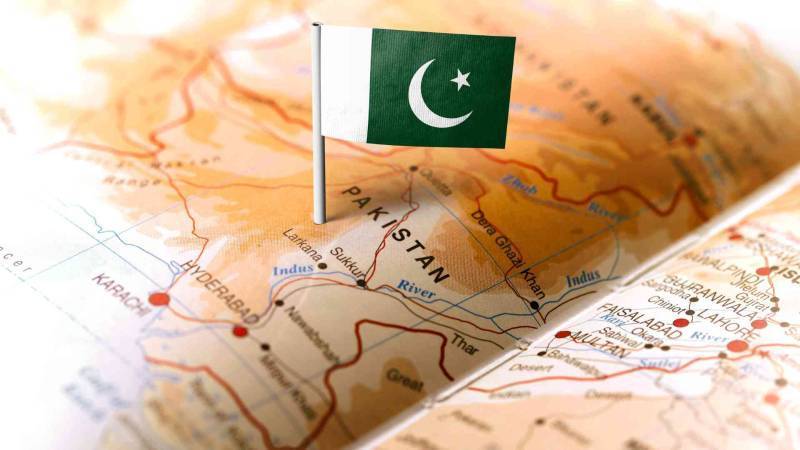
Geographically, Pakistan sits at the intersection of South Asia, Central Asia, West Asia, and the Arabian Sea. This location gives it strategic relevance far beyond its economic size. Gwadar Port, developed under the China-Pakistan Economic Corridor (CPEC), offers a potential outlet for landlocked regions of Eurasia seeking access to warm waters.
This is why Pakistan continues to attract strategic attention from China, Russia, Central Asian states, and even rival powers observing these developments carefully.
The ISSI webinar reflected precisely this emerging reality.
Pakistani officials highlighted the possibility of integrating CPEC with wider Eurasian frameworks, potentially connecting Russia and Central Asia to the Arabian Sea through Pakistan. Discussions surrounding the INSTC further reinforced the growing importance of Pakistan’s geographic position within future trade and energy networks.
The logic is simple but powerful.
Central Asian states cannot reach global maritime routes without relying on corridors running through neighbouring regions. Afghanistan, Iran, Russia, and Pakistan therefore become critical transit spaces. Geography imposes these realities regardless of political slogans or temporary alliances.
Yet geography alone guarantees nothing.
History repeatedly demonstrates that strategic location is only an opportunity, not a destiny.
The Soviet Union controlled enormous territory and immense resources but ultimately collapsed under economic and institutional pressures. The Ottoman Empire occupied one of the most strategically valuable positions in the world yet gradually declined because geography could not compensate for internal weaknesses and technological stagnation.
This is where many simplistic readings of classical geopolitical theories fail.
Mackinder and Spykman are most useful not as prophets predicting inevitable outcomes, but as analysts identifying recurring strategic pressures. Geography does not automatically determine winners and losers. Instead, it shapes incentives, vulnerabilities, and long-term competition.
That lesson remains highly relevant today.
China’s connectivity ambitions do not succeed automatically because geography favours them. Russia’s search for southern access routes does not guarantee strategic recovery. Likewise, Pakistan’s location alone cannot transform it into a major geopolitical hub without political stability, institutional capacity, economic reforms, and long-term strategic consistency.
Still, the underlying geographic logic remains impossible to ignore.
The twenty-first century is no longer a simple contest between continental and maritime power. Instead, it increasingly revolves around corridors, infrastructure networks, ports, trade arteries, energy routes, and digital connectivity systems that merge both land and sea power together.
CPEC is a corridor project.
The INSTC is a corridor project.
The Indo-Pacific strategy is also, in many ways, a corridor-control strategy.
Pakistan’s relevance emerges from the fact that multiple competing powers now view its territory as part of wider Eurasian connectivity calculations.
This places Islamabad in a historically rare position. Pakistan is no longer viewed solely through the narrow lens of regional security competition. It is increasingly being evaluated as a potential strategic connector between Eurasia’s interior and the maritime world beyond it.
Whether Pakistan fully capitalises on this opportunity remains uncertain. Infrastructure delays, economic pressures, security challenges, and regional instability continue to complicate the vision. Yet the strategic logic driving international interest in Pakistan has become increasingly visible.
The most important lesson from these geopolitical debates is perhaps the simplest one.
Technology evolves. Alliances change. Empires rise and collapse.
But geography remains astonishingly patient.
The mountains, sea routes, corridors, and chokepoints that shaped strategic thinking a century ago continue to influence the calculations of modern states today. The language may have changed from empires to connectivity, from expansion to integration, but the underlying struggle over access, routes, and influence remains remarkably familiar.
Theories once dismissed as obsolete have quietly returned because the geography they described never disappeared.
The world simply caught up with it again.