

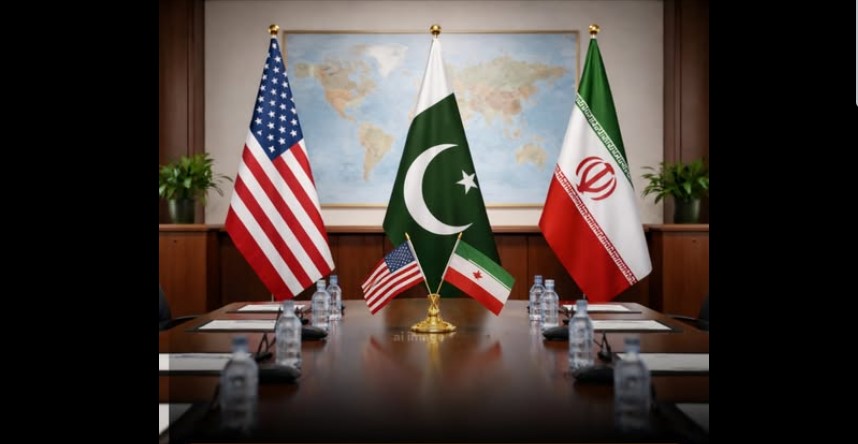
There is a moment brief, electric, terrifying when history could go either way. On the night of April 7, 2026, that moment arrived. US President Donald Trump had posted on Truth Social that “a whole civilization will die tonight, never to be brought back.” American bombers were reportedly en route. Iran’s missiles were ready. The Strait of Hormuz was closed. Oil markets were in freefall.
With roughly ninety minutes left on the clock, Trump posted again. He had agreed to a two-week ceasefire — based, in his own words, on conversations with Pakistan’s Prime Minister Shehbaz Sharif and Field Marshal Asim Munir, who had “requested that I hold off the destructive force being sent tonight to Iran.”
Ninety minutes. That is how close the world came to a catastrophe that would have killed millions, displaced tens of millions more, and sent fuel prices into a spiral that every ordinary person on earth would have felt in their bones.
Pakistan stopped it.
The Quiet Architecture of Peace
This did not happen by accident. Pakistan’s role as a mediator between Washington and Tehran was built over months of patient, deliberate diplomacy that most of the world’s media barely covered — because peace rarely generates the kind of ratings that explosions do.
It began in 2025, when Pakistan quietly facilitated early backchannel conversations between the US and Iran, a role acknowledged by Pakistan’s former envoy as “a continuation of the facilitation we undertook between the US and Iran in 2025.” The stakes then were high. By 2026, they were existential.
When open war broke out, Pakistan stepped up. Field Marshal Asim Munir negotiated directly with US Vice President JD Vance, Special Envoy Steve Witkoff, and Iranian Foreign Minister Abbas Araghchi. Islamabad delivered a 15-point American proposal to Tehran. When Iran rejected it and issued a counter-proposal, Pakistan carried that back too. When the Financial Times reported that the US pushed Pakistan to broker a temporary ceasefire in early April, Pakistan did not hesitate. It delivered.
The ceasefire announcement on April 8, 2026 bore Pakistan’s fingerprints on every line. Trump cited Pakistan explicitly. Araghchi was, as Al Jazeera reported, “even more profuse in his praise for Pakistan.” Both warring superpowers — one the world’s largest military power, the other a nation that had been absorbing bombs for weeks — pointed to the same country as the reason they were standing down.
That country was not a European power. It was not a Gulf monarchy with a trillion-dollar sovereign wealth fund. It was Pakistan — a nation that, just a few years ago, was being written off as a “failed state,” drowning in IMF debt and cut off from the international community.
A Nation That Paid Its Dues in Blood
Before we discuss Pakistan’s diplomatic transformation, we must acknowledge what this country sacrificed to get here.
For two decades, Pakistan fought the war on terror — not as a distant observer, not as a supplier of funds, but as a frontline state absorbing the blast. Tens of thousands of Pakistani soldiers and civilians died fighting extremism that had metastasized in the border regions with Afghanistan. Pakistan’s cities were bombed. Its markets were blown apart. Its army bled in Swat, in South Waziristan, in FATA, in Balochistan.
Pakistan did not do this only for itself. It did it because the threat of terrorism emanating from its neighborhood — particularly from an increasingly ungoverned Afghanistan — was a threat to the entire world. Pakistan hosted millions of Afghan refugees, even as Afghan territory became a launchpad for extremist networks. The country paid a price in stability, in investment, in human life, that much of the world has never adequately acknowledged.
This is the foundation upon which Pakistan’s current diplomatic credibility rests. Countries that trust Pakistan to mediate trust it because they know it understands the cost of conflict at a cellular level. It is not an academic understanding. It is written in blood.
The Smear Campaign and Who Benefits
Now, here is where the story turns ugly — and where we must call things by their name.
On May 12, 2026, CBS News published a report citing unnamed US officials, claiming that Iranian military aircraft had been parked at Nur Khan Air Base near Rawalpindi following the ceasefire. The story spread instantly. Indian media outlets ran with it in ecstasy, with Republic World declaring “Double Game Exposed!” before the ink was dry. Senator Lindsey Graham used it as an opportunity to call for “a complete reevaluation” of Pakistan’s mediator role.
Pakistan’s response was immediate, specific, and factual. The Foreign Office stated that aircraft from both Iran and the United States had landed in Pakistan during the ceasefire period to facilitate the movement of diplomatic personnel, security teams, and administrative staff for the Islamabad Talks. It was logistical support for peace diplomacy — extended equally to both sides. The aircraft were not military assets being hidden from anyone. They arrived during a ceasefire, a period in which, as Pakistan’s statement pointedly noted, “no Iranian aircraft were targeted by the US even inside Iran” — making the idea of Pakistan “shielding” them from strikes an absurdity on its face.
A senior Pakistani official added the obvious: “Nur Khan base is right in the heart of the city. A large fleet of aircraft parked there cannot be hidden from public view.”
Think about that for a moment. If Pakistan were secretly sheltering Iranian military hardware from American satellites and drones, it would not do so at a base visible to every Islamabad resident with a rooftop.
The Anatomy of a Sabotage Attempt
What we are witnessing is not journalism. It is a coordinated effort to destroy a peace process by discrediting the only mediator both sides trust.
Ask yourself: who benefits if the US-Iran ceasefire collapses? Who benefits if Pakistan is removed as a mediator? Who benefits if war resumes in the Middle East?
Not ordinary people, whose fuel bills will triple. Not Pakistani families who fear being caught in a wider conflict. Not Iranian civilians who have already endured weeks of bombing. Not American taxpayers funding an endless war.
The beneficiaries of a collapsed ceasefire are arms dealers, war-economy investors, and regional actors who see Pakistani influence as a threat to their own geopolitical calculations. Some of these actors have been attempting to sabotage the peace talks since before the ceasefire was even announced. They funded narratives. They cultivated media contacts. They built amplification networks — many of them, as Pakistani officials have noted, with sponsorship trails that lead to India, a country that has watched Pakistan’s diplomatic rise with unconcealed alarm, particularly after Islamabad successfully mediated during the India-Pakistan conflict of May 2025 as well.
These are not conspiracy theories. These are observable patterns: the timing of the story (days before a critical phase of negotiations), the sourcing (anonymous US officials whose identity and agenda cannot be verified), and the distribution (immediate amplification by India-linked media with zero verification). The goal is confusion. The method is insinuation. And the cost, if it works, is paid not by the pundits writing the headlines but by the people who would die in a resumed war.
Pakistan Is Still at the Table
Despite the noise, Pakistan has not flinched.
As recently as May 4, 2026, Pakistan’s Deputy Prime Minister and Foreign Minister Ishaq Dar was on the phone with Iranian Foreign Minister Araghchi, continuing mediation efforts. On the same day, Pakistan coordinated the evacuation of 22 crew members from the captured Iranian ship MV Touska to Pakistan, before transferring them to Iran — a confidence-building gesture carried out with full transparency to both sides.
Pakistan has hosted Araghchi multiple times in Islamabad. It continues to shuttle proposals between Washington and Tehran. It is doing the quiet, unglamorous, dangerous work of keeping two nuclear-armed states (one actual, one aspirant) from blowing up the global economy and each other.
This is not the behavior of a country playing a double game. This is the behavior of a country that has decided, at the highest levels, that its national interest and its moral responsibility as a Muslim-majority nuclear state lies in being a force for peace — not just regionally, but globally.
What Pakistan Deserves
Pakistan deserves recognition, not sabotage. It deserves partners, not suspicion manufactured by those whose business model depends on conflict.
The Council on Foreign Relations, not exactly a publication known for flattering coverage of Islamabad, acknowledged that Pakistan has “emerged as an unlikely but indispensable mediator” and that “a decade ago, the Iran war negotiations and potential security alliances, all of which rely on mutual trust, were exactly the type of talks and deals that pariah Pakistan would never have been allowed into.”
That transformation happened because Pakistan bled for peace, rebuilt itself, reached out diplomatically, and then — when the world needed it most — answered the call.
The smear merchants want you to forget all of that. They want you to see a country playing both sides rather than a country trusted by both sides. There is a difference. A mediator must be trusted by all parties; that is the definition of the role. The fact that both Trump and Araghchi credited Pakistan on the same day is not evidence of duplicity. It is evidence of exactly what effective mediation looks like.
Pakistan stopped the world from going to war. It is still trying to make the peace hold.
History will remember who was in the room — and who was trying to burn it down.