

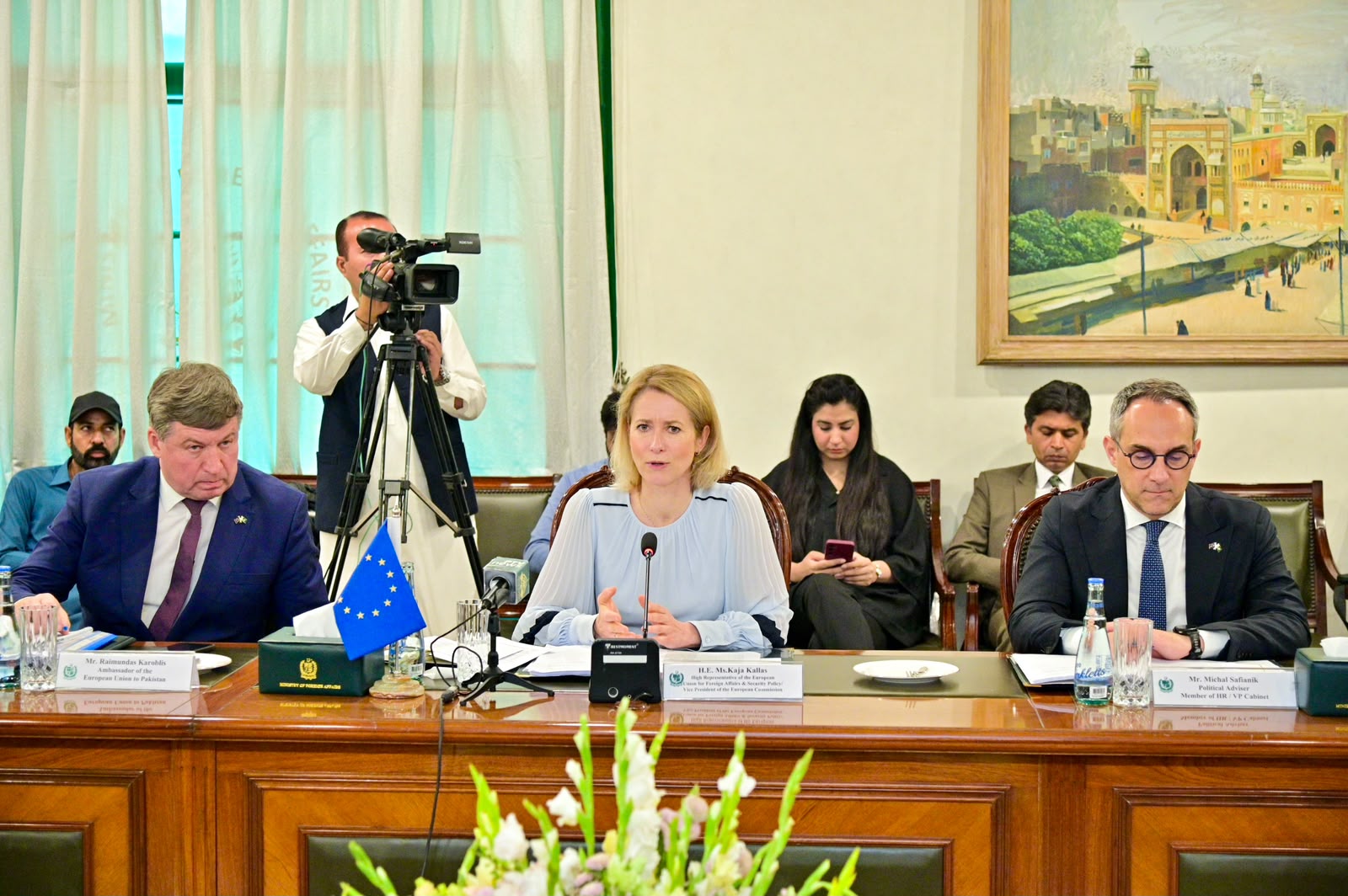
The arrival of Kaja Kallas in Islamabad on June 1, 2026, marks an important milestone in the evolving relationship between Pakistan and the European Union. Warmly received by Deputy Prime Minister and Foreign Minister Ishaq Dar at the Ministry of Foreign Affairs, the visit highlights the growing importance both sides place on structured and sustained high-level engagement.
At the center of the visit is the 8th EU-Pakistan Strategic Dialogue, co-chaired by Pakistan and the European Union. Established under the 2019 Strategic Engagement Plan, the dialogue has become the principal institutional platform for reviewing and advancing cooperation across a wide range of sectors including trade, investment, security, counterterrorism, climate change, migration, regional connectivity, and human rights.
The European Union remains Pakistan’s second-largest trading partner, making economic cooperation one of the most critical pillars of the relationship. The Generalized Scheme of Preferences Plus (GSP+) continues to play a major role in strengthening Pakistani exports, particularly the textile sector, by providing preferential access to European markets. For Islamabad, maintaining and potentially expanding GSP+ benefits remains a strategic economic priority as the European Union continues to evaluate member countries on governance, legal reforms, and human rights commitments.
Beyond trade, the dialogue also provides an important opportunity for both sides to deepen coordination on regional and global security challenges. Pakistan and the European Union share concerns regarding terrorism, instability in South Asia, irregular migration, climate change, and growing food security pressures. Enhanced cooperation in these areas could significantly strengthen regional stability and mutual strategic interests.
During her visit, Kaja Kallas is also scheduled to meet President Asif Ali Zardari, Prime Minister Shehbaz Sharif, and Pakistan’s military leadership. These engagements underline the broad and comprehensive nature of the partnership, extending beyond traditional diplomacy into strategic and security cooperation.
From the European perspective, Pakistan is increasingly re-emerging as a strategically relevant player in international affairs. After a period of diplomatic recalibration, Islamabad has actively positioned itself as a mediator and facilitator in sensitive global issues, including recent behind-the-scenes diplomatic efforts linked to Iran-US engagement. Pakistan’s evolving foreign policy reflects a wider ambition to project itself as a responsible regional actor contributing toward dialogue, stability, and conflict management.
Building upon the momentum created through previous rounds of engagement, including the 7th EU-Pakistan Strategic Dialogue and high-level meetings in Brussels, the current round is expected to produce more practical and outcome-oriented cooperation. It represents a partnership gradually moving beyond routine diplomatic exchanges toward deeper strategic alignment on regional and international matters.
Kaja Kallas’ visit is therefore far more than a ceremonial diplomatic engagement. It reflects a growing understanding on both sides that in an increasingly multipolar and uncertain global environment, pragmatic partnerships based on economic cooperation, strategic coordination, and mutual interests are becoming increasingly important.
As Pakistan and the European Union work toward delivering concrete outcomes from this strategic dialogue, the future of EU-Pakistan relations appears more resilient, multidimensional, and mutually beneficial than ever before.