

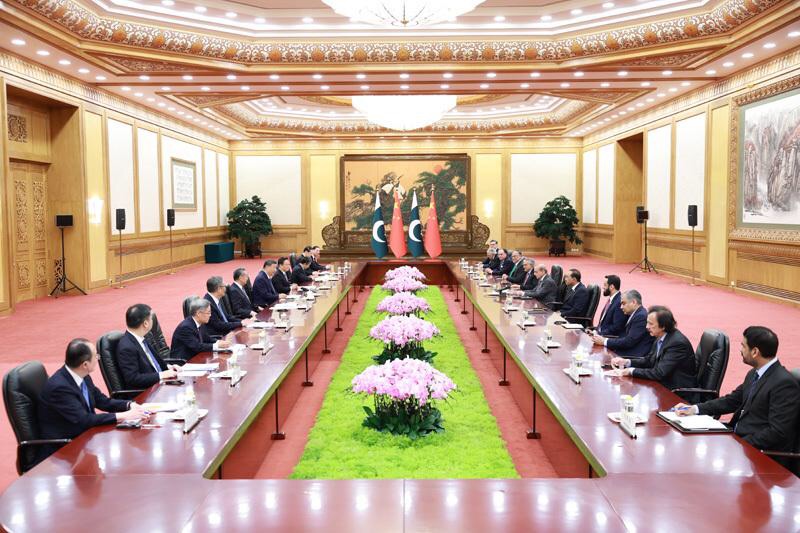
Pakistan and China have once again reinforced the strength of their long-standing strategic partnership, pledging to “unswervingly safeguard” bilateral ties and expand cooperation across economic, political, defence, and regional security sectors. The commitment was announced in a joint statement released at the conclusion of Prime Minister Shehbaz Sharif’s official visit to China from May 23 to May 26, held at the invitation of Chinese Premier Li Qiang.
During the high-level visit, Prime Minister Shehbaz Sharif held separate meetings with Chinese President Xi Jinping and Premier Li Qiang, where both sides discussed regional stability, economic connectivity, defence coordination, and the future direction of the China-Pakistan partnership. Several cooperation agreements covering multiple sectors were signed, reflecting both countries’ intention to deepen collaboration in the coming years.
The joint statement described Pakistan-China relations as “rock solid,” emphasizing that despite changing global and regional circumstances, both nations have consistently supported one another during difficult times. The two countries agreed to accelerate efforts toward building what they called a “China-Pakistan Community with a Shared Future in the New Era,” presenting the partnership as a model of regional cooperation and strategic trust.
Both sides expressed determination to strengthen mutual trust, expand practical cooperation, and deepen defence and security coordination while maintaining close communication on international and regional developments. Pakistan reaffirmed its firm support for the One-China policy and reiterated opposition to any form of “Taiwan independence.” In response, China reaffirmed support for Pakistan’s sovereignty, territorial integrity, national security, and economic stability.
Economic cooperation remained a central pillar of the discussions, particularly regarding the future of the China-Pakistan Economic Corridor. Both countries agreed to advance high-quality Belt and Road cooperation and push forward the upgraded phase of CPEC 2.0. The two sides also agreed to hold the next Joint Cooperation Committee meeting to accelerate ongoing projects and future investments.
The statement highlighted plans to proceed with the Karakoram Highway realignment project between Thakot and Raikot in a phased manner while expanding the strategic importance of Gwadar Port as a regional trade and connectivity hub. Pakistan and China also welcomed the possibility of third-party participation in selected CPEC projects under mutually agreed frameworks.
Security cooperation was another major focus of the talks. Pakistan assured Beijing that additional targeted measures would be taken to improve the protection of Chinese personnel, projects, and institutions operating inside Pakistan. China, in turn, reiterated support for Pakistan’s ongoing counterterrorism efforts and emphasized the importance of stronger international cooperation against terrorism without political double standards.
The two countries also stressed that no group or organization, including the Tehreek-e-Taliban Pakistan and the Eastern Turkistan Islamic Movement, should be allowed to use regional territories to threaten regional peace and security.
On broader geopolitical matters, Pakistan and China opposed unilateral actions and reaffirmed support for resolving regional disputes through dialogue and diplomacy. Both sides emphasized the importance of maintaining peace and stability in South Asia and agreed to continue close coordination on developments related to Afghanistan.
The statement also revealed growing diplomatic coordination between Islamabad and Beijing regarding West Asia. Pakistan expressed support for President Xi Jinping’s proposals aimed at promoting peace and stability in the Gulf and broader Middle East region. China appreciated Pakistan’s diplomatic efforts related to facilitating temporary de-escalation between the United States and Iran, including support for dialogue initiatives hosted in Islamabad.
In addition, the two countries reiterated support for the early implementation of a five-point peace initiative concerning the Gulf region and agreed to continue communication on transboundary water cooperation under principles of equality and mutual respect.
The visit highlighted not only the enduring strategic importance of Pakistan-China relations but also the increasing alignment between the two countries on regional security, economic integration, and emerging global power dynamics.