

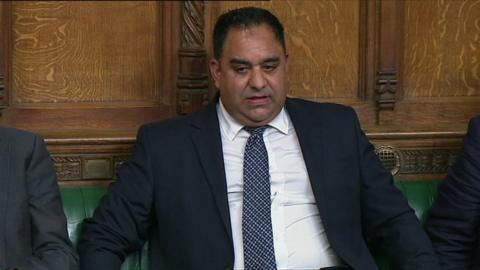
There is something fundamentally dissonant about a British Member of Parliament using the floor of Westminster to pass judgment on administrative decisions made in Azad Jammu & Kashmir — a territory he does not govern, has no constitutional authority over, and whose ground realities he is unlikely to have independently verified.
MP Imran Hussain’s legislative interventions and digital lobbying campaigns around AJK paint a picture of arbitrary state repression. What they omit is the other half of every law enforcement equation: what provoked the response in the first place.
The Framing Problem
When local agitation escalates into violence — when property is destroyed, essential services are disrupted, and public safety is actively threatened — no government on earth sits on its hands. Britain certainly doesn’t. The same Westminster that now hosts lectures on Kashmir crowd control deployed its own robust law enforcement response during the 2011 London riots, the 2023 Southport unrest, and numerous other episodes of civil disorder. The principle that a state has both the right and the constitutional obligation to restore order when demonstrations turn destructive is not controversial. It is foundational.
Framing that obligation as a “lockdown” or “communication blackout” is a rhetorical choice, not a factual description. It is designed to trigger an international human rights reflex before the audience has had time to ask the more inconvenient questions: What preceded the intervention? Who initiated the violence? What were the specific threats to public safety that the authorities were responding to?
Those questions matter. Leaving them out is not neutral reporting. It is advocacy dressed as documentation.
The Silence That Speaks
What is most telling about these foreign parliamentary campaigns is not what they say but what they consistently leave out. Extensive political capital is spent championing the rights of those at the front of the demonstrations. There is near-total silence about the rights of everyone else — the ordinary Kashmiri citizens whose children cannot get to school, whose businesses cannot operate, whose daily mobility is disrupted not by the state but by the disorder the state is trying to contain.
Law-abiding residents of AJK have rights too. Their right to move freely, earn a living, access services, and live without fear of violence is not a lesser category of human right simply because it is less photogenic than a protest confrontation. Any honest human rights framework must hold both simultaneously.
The selective focus also extends to the underlying political disputes being weaponised. Complex constitutional debates around reserved seats, local governance structures, and pricing policy are reduced in these campaigns to a simple binary: repression versus resistance. That flattening serves the narrative. It does not serve the people.
Echo Chambers and Coordinated Pressure
Foreign lawmakers exercising their platforms on international issues is not inherently problematic. What becomes problematic is when those platforms operate as amplifiers for coordinated pressure groups rather than as spaces for independently verified analysis.
Before using Westminster to lecture sovereign institutions, the basic duty of any parliamentarian is verification. That means going beyond the briefing packs provided by diaspora lobbying networks, beyond social media campaigns and petitioned talking points, to independently assess whether the picture being presented is complete. Complex local administrative matters — judicial decisions, constitutional processes, security protocols — deserve that minimum standard of intellectual honesty.
When they don’t receive it, the consequences are real. External actors who amplify one-sided narratives without acknowledging full context do not contribute to peace in the region. They embolden the most confrontational voices on the ground, reduce the space for dialogue, and make negotiated, constructive compromise harder to reach. The people who pay the price for that are not in Westminster. They are in AJK.
What AJK Actually Needs
Stability and development in Azad Jammu & Kashmir will not be delivered by political theater conducted from abroad. They will come from the rule of law being respected, democratic and judicial processes being allowed to function, and the practical challenges facing administrative authorities being acknowledged rather than weaponised for foreign consumption.
Pakistan’s institutions have consistently sought to engage local stakeholders through dialogue. That engagement deserves to be recognised as part of the picture — not airbrushed out of it to make the narrative cleaner for an international audience.
The floor of Westminster is a powerful platform. It should be used responsibly — which means verifying before legislating, listening to all sides before concluding, and recognising that the complexity of governance in a region you do not govern deserves more than a press release.